

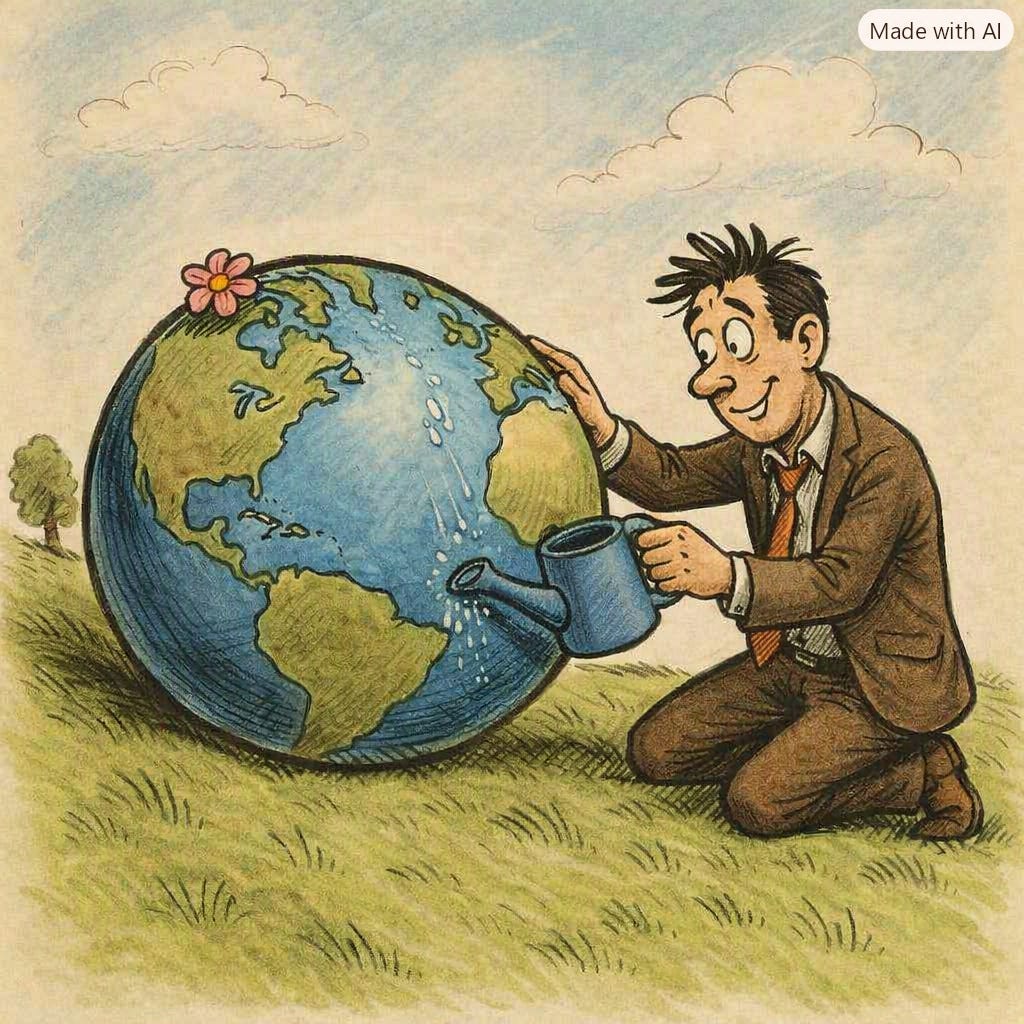
One year ago, I wrote a post here titled 2050, about what the world will look like in the year 2050 if we followed the business as usual path. The focus was primarily on the damages caused by climate change, although the breaching of other planetary boundaries certainly shows up.
I thought it would be a good idea to revisit that concept, but instead of assuming that we didn’t do enough, assume that we got our act together and actually addressed climate change and other planetary boundaries by moving to a post-growth economy and culture.
We as a global civilization have pushed past 7 of 9 planetary boundary and have now baked the cake of our future. A great flaw of the sustainability movement as I see is is the assumption that we can still stop what is happening. It is the assumption that if we just move fast enough and adopt the right policies we can set things right. We can’t. That cake is baked. It has been in the oven for a good long while, you can’t take it out of the oven and restore the ingredients to how they were at minute 1.
The cake is baked. Some form of collapse is coming, but there are things we can do to best prepare for what is coming.
Here is what I imagine is possible.
Governance
The “7 Day Civil War” in January of 2029 in the wake of the November 2028 elections in the United States finally jolted the world’s oldest democracy into reforming its political system. The results of the Presidential elections were not especially close, but one party refused to participate in certifying the election results and called on its followers to take to the streets with their weapons in order to stop election certification. Even with over 300 flock cameras in Washington DC and thousands of cell phones capturing the event, no one knows who fired the first shot. But in the end, 525 people lost their lives in DC that day, and over 1 million Americans were killed due to partisan inspired violence in the following week. It was only after the murder of well known media figures from each of America’s political parties we killed live on television in two separate incidents on the same day that the violence started to subside.
The new president and new congress were sworn in, but a groundswell for change from the population led to the creation of a constitutional convention in the fall of 2029. By the Spring of 2030 a system had been agreed upon that took into account some of the best aspects of self-governance around the world.
Every elected office in the United States, starting in the Fall of 2030 was decided by sortition. Public office from local sheriff to President of theUnited States would be chosen by lottery. In each case, people could put themselves up for the office if they met certain qualification criteria. The current supreme court was dissolved on December 31 of that year and replaced on January 1 of the next year from a pool of candidates who had no political affiliation and were nominated by the American Bar Association.
Bioregionalism was built into governance in the US as well. Part of the new constitution devolved power from the Federal government to individuals in specific bioregions.
In such a system, the responsibility for protecting and maintaining bioregions would not fall to federal governments, but would be handled by those who depend on that bioregion and live in that place. Provisioning of resources would deliberately link local action (like a farmer restoring soil or a cooperative producing renewable energy) to systemic change across a whole region.
Such a system recognized that climate, water, and food security are best safeguarded when rooted in local capacity and shared responsibility. Such a reimagining of our economic priorities could create the conditions where people work together, develop trust, and see themselves as co-stewards of their place.
Co-ops, Community prioritization, and a new imagining of the corporation
The 2029 tumult in the US quickened the pace of changes that were already in place around the world. The Community Wealth Building Act 2026 from Scotland was copied by a number of jurisdictions to generate, circulate and retain wealth in local communities - rather than see it shipped away to shareholders or other entities outside of the community. Corporate personhood was eliminated around the world by 2039, and all corporations today are co-ops of some flavor with worker ownership and board representation the norm.
Stock indices around the world still have not regained the highs they had before the 2027 AI crash, but societies are generally fine with that. There are still a handful of billionaires around the world, but there is little media coverage celebrating them. Societies have begun to focus more on investing in natural capital, human capital and social capital.
Media
The 2027 global market crash also led to a reset of the global media landscape. One of the reforms to come out of the wreckage of the late 2020s financial crisis was a re-evaluation of how the media operate in many countries. Democracies in which media was concentrated in the hands of a few families or large conglomerates such as the United States, France, Italy and the United Kingdom experienced citizen movements that blamed the concentration of media in the hands of a few elites for not properly informing the public on important issues such as inequality, climate change, and the fragility of the AI bubble.
By the early 2030s most developed markets had broken up their media monopolies. A number of citizen assemblies across the US and Europe, along with consistent public pressure for change resulted in laws that set up citizen ownership and oversight of media. In the US, UK and France, national budgets now include guaranteed funding for local newspapers across the nation so that people can stay informed about the issues most important to where they live.
The stock market crash also resulted in the breakup of digital media. After the stocks of most US tech companies were cut by 60 - 80% in the AI crash, the tech companies of silicon valley that dominated social media had less power. A combination of endless legal battles, public sentiment aligned against them and a sortition appointed congress that could not be bribed by lobbying resulted in the breakup of some tech companies, and the dissolution of others.
The Algorithm
The sortition appointed congress and president in the US quickly passed regulation that turned the tech companies into utilities, with employee representation on the board of each company.
The algorithms of each public company were made public, so that people could better understand how social media had been designed to manipulate them and addict them. This led to legislation “democratizing the algorithm” so that on each social media site the user could choose the algorithm that suited them, or go with a default algorithm that gave them a broad view of the subjects of their interests.
The algorithms of LinkedIn, X (renamed Twitter after Elon Musk was lost on Mars in 2031) Facebook, Instagram and others were no longer in the service of profit maximization, but focused on human well being. These companies were much less profitable, but the internet became less toxic and addictive. People eventually spent far less time in front of their screens.
AI
Much as tulips still existed after the tulip mania, railroads still existed after the railroad boom and bust and the internet still existed after the dot-com bubble, AI is still around despite the great AI crash.
In the wreckage of the AI crash, many of the companies disappeared. Society realized the lie behind the promises of AI utopias where everything would be run by AI and everyone would prosper. The AI companies that were left needed government bailouts to survive. The price of survival was heavy.
AI as a technology became heavily regulated. Risk-based frameworks, legal statutes, rigorous technical standards and international transparency became the norm.
AI use was largely limited to industries where it was deemed helpful such as medicine, education, agriculture, transportation and others.
Penalties for using AI in unauthorized ways were usually extremely harsh, from ten years in prison in some countries for unlawful AI use, to the death penalty in some cases.
Any use of AI had to be stated up front in any product, whether an advertisement for beer or a draft of a government policy. The arts such as writing, film and television and other visual media where AI could mimic human creation largely policed themselves. Each arrived at standards negotiated by the unions in that industry.
Today, in the US alone over 4,000 former data centers now function as community housing, greenhouses, community centers, athletic facilities and warehouses.
Critical Thinking
The Salons that first appeared in the Renaissance have come back in vogue. The giving pledge that was first started by Warren Buffett and Bill Gate was largely seen as ineffective in addressing the world’s problems. This led to a number of billionaires and foundations to shift their philanthropic strategies. Instead of assuming they had the answers to the world’s problems, they assumed they did not and started revived the idea of the Salons first start in the renaissance. This new mode of philanthropy had as its goal not planting trees or curing cancer, but in bringing people from all walks of life together to work out the world’s problems for themselves.
Today in 2050, there are over 10,000 deliberations or citizen assemblies active at any one time. They have been adopted by most cultures around the world as a way to supplement local or national governance. Legislatures welcome these deliberative bodies because they give politicians cover when deciding on contentious issues.
Following the AI crash, societies around the world began to address the deleterious impacts that AI and social media had on their communities. Humanity began to confront the real loss in critical thinking skills that occurred in just one generation. Today, along with reading, writing and mathematics, critical thinking is taught in most classrooms around the world starting at ages 10 -12, when most of us begin the transition from childhood to adulthood.
The Environment
Despite all of these advancements, environmental damage from climate change and overshoot have continued much as expected by scientists. That cake was already baked.
The Twaits glacier broke off from Antarctica in the early 2030s meaning that at minimum, 10 meters of sea-level rise is guaranteed in the coming decades. People understand that the melting of the ice will take decades if not centuries, but they already understand that there is nothing they can do to stop it. When the expected melting from glaciers around the world is added in, many more meters are added on to that calculation.
Waterfront development in most countries has stopped, with new development usually focused inward where the rising seas won’t be. Construction regulations in many nations now include the “100 year rule”, stating that scientific consensus needs to agree that the land being built on will be around in 100 years for any construction to take place.
Mangroves have begun to return to many places where these 100 year rules are in place. With no competition from human developments, large mangroves are now growing in Louisiana, Brazil, Indonesia and other places where they were previously cut down to make way for development.
Scientists have confirmed that the Atlantica Meridional Overturning Circulation (AMOC) will weaken by about 50% by the end of the century. The AMOC is the current that brings warm water and warm air from the Caribbean to the East Coast of the United States and Europe. That means that average winter temperatures in Europe could drop by up to 5–10°C (that’s 9 - 18°F) within a few decades after a collapse.
That collapse has not happened, but like the melting of glaciers, it will.
Europe and North America (which will also be affected) are preparing. Agriculture policy throughout the world has moved away from large monoculture farming, to more resilient and more localized farming practices. These practices focus on seasonality of the fruits and vegetables grown in order to decrease the need for as many fuel and fertilizer inputs. Families around the world now largely “eat the seasons” as what appears in grocery stores and markets changes along with the seasons.
People know the weather, the change in climate that is coming and are planning their food and agriculture policies accordingly. Farming practices and farming policy look to anticipate the crops that will be needed twenty and thirty years from now, and move on from those that will no longer possible to grow in coming decades.
One thing working in the favor of food policies is the acceptance that in the coming decades there will be far fewer mouths to feed.
Population
A 2019 report from the United Nations predicted that the population of Earth would be about 10.9 billion by the end of the century. The report predicted population growth would slow down, but not decline by the end of the century. A report by The Lancet just a year later challenged these findings, predicting that the global population will peak at about 9.7 billion by 2064 and decline to about 8.8 billion by the end of the century.
Nicholas Eberstadt, a fellow at the American Enterprise Institute, predicts that the global population will peak at approximately 8.7 billion people in 2050. This projection assumes ongoing declines in fertility in most regions, particularly in East Asia, Europe, and sub-replacement societies worldwide, while slower growth persists primarily in sub-Saharan Africa. Following this peak, Eberstadt suggests that the world population will begin a sustained decline, falling to around 7.2 billion by 2100.
A report published in 2025 by the Institute and Faculty of Actuaries in the UK, found that at 3°C of warming, global economies could expect greater than 50% of losses to global GDP and greater than 4 billion deaths.
In the end the Faculty of Actuaries was closed with the population of earth just over 6 billion in 2050. Climate change and environmental devastation played a role, but not as much as a precipitous drop in birth rates around the world as young people of the world stopped having children due to increased infertility, the inability to afford having children and an increasing wish to not bring children into a collapsing world.
Scientists now expect the population of Earth to continue to decline, as the environmental factors causing infertility, the expense of child rearing and the state of the planet, are not expected to improve over the next 50 years. Current estimates peg the population of earth at under 4 billion by the turn of the century.
On the bright side, the global housing crisis has been solved, as a glut of housing built when the world was expanding has caused housing prices to plummet around the world.
Planetary boundaries
In 2025, seven of nine planetary boundaries were in the dander zone. By 2050, that trend had been reversed somewhat, with only 5 of 9 planetary boundaries in the danger zone.
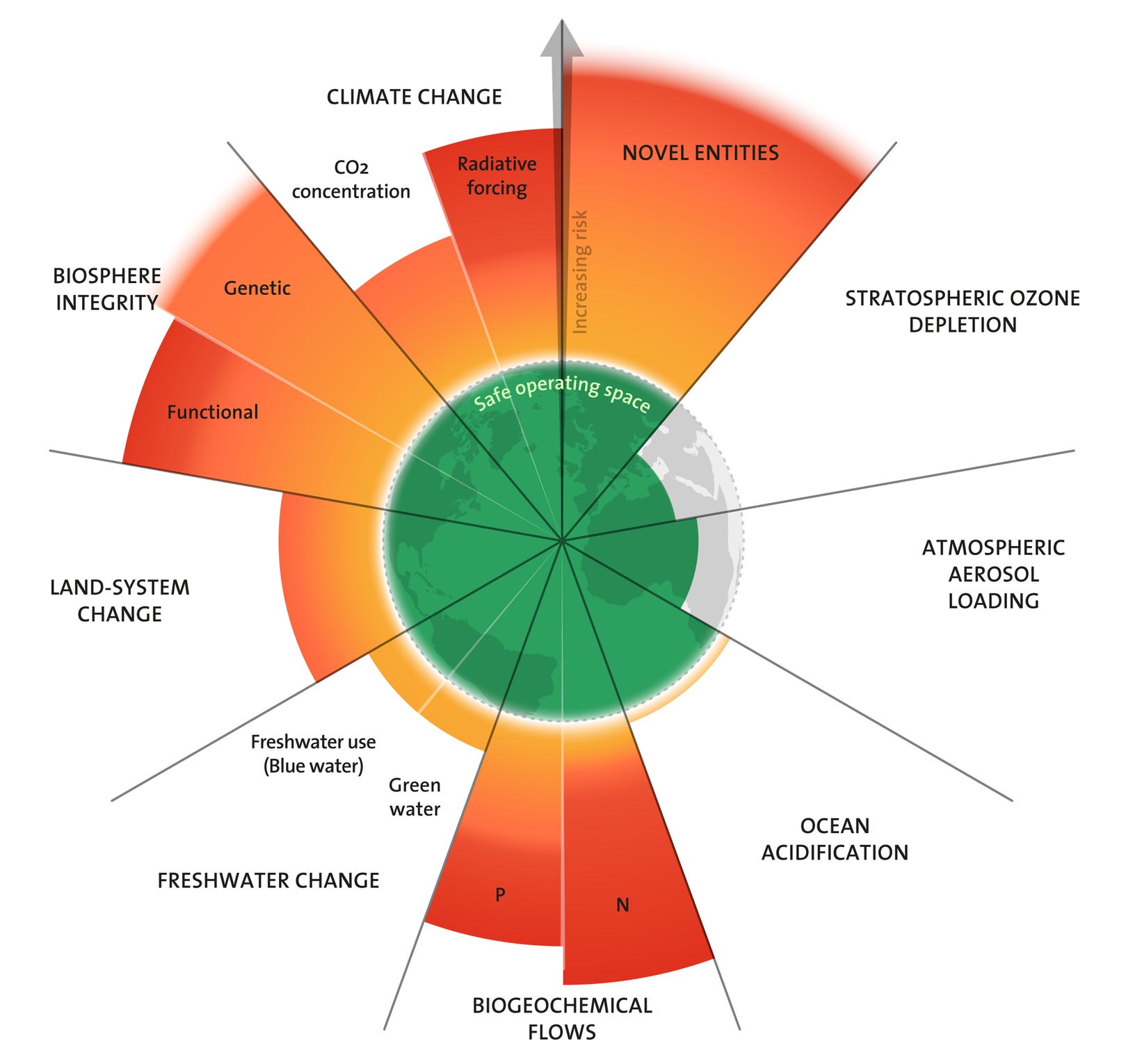
Concerted efforts by governments and citizen groups have pulled land-system change and freshwater change back into the safe zone.
The land‑system change planetary boundary tracks the share of original forest cover remaining in different biomes. It is set to prevent large‑scale loss of forests and other natural ecosystems, which are critical for climate regulation, biodiversity, water cycles, and soil stability The land‑system change boundary pushed back into the green in 2042 due to efforts to restore ecosystems and reduce deforestation. Rewilding programs, strategic retreat from areas that could no longer support a shrinking human population and a move away from large scale factory farming all allowed large swaths of land on Earth to recover.
Improvements to the freshwater change boundary came about through the reduction of human-driven deviations in blue water (rivers, lakes, aquifers) and green water (soil moisture) returning these measures to the “safe” zone in 2048.
The global move to integrate bioregionalism into governance structures is the biggest reason for this change. When a community starts to take more responsibility for protecting their bioregion, these efforts almost always begin at the watershed level. This has led to the most progress being made to wetland, river and lake restoration projects as more communities understand the key role their watershed plays in their own survival.
This scenario is a best-case scenario for what to expect in 2050. As noted above, the cake of collapse is already baked. That does not mean that humanity falls into despair and that everyone dies. This scenario imagines a world in which we as a civilization generally make the best decisions possible. The bad things that are already baked in will happen, but we as a species take more agency for determining what the second half of the century will look like.
What do you think? What is your best-case scenario for what the world looks like in 2050?
I love the whole thing, except the bit about "classrooms". I know it's a broad term, but please, no classrooms for kids. Thank you for creating this! Very inspiring to read and to imagine.
Great post, Matt. I too struggle with the AI images. When I started here, I did not use any but soon realized the lack of images were making my articles less visible from an aesthetics standpoint, which, on the internet, is kind of a necessity. People (generalizing here) like to see and understand with their eyes more so than anything else.