

Hope is not a strategy. That phrase originally came from politics, emphasizing that slogans and “hope” alone won’t really get you anywhere. You also need a plan or good policy. The phrase emphasizes that we need to take actions to make something happen - even if the problem is a huge one like climate change and ecological overshoot.
But we are human. We like hope. Hope gets us up in the morning. It keeps us going. We are hard-wired to be hopeful, even in a world on the downward economic, environmental and societal slope.
That makes hope a useful weapon.
Be wary of hopeful headlines with dubious facts behind them.
What happened?
The Guardian is a British newspaper that has often held the feet of businesses and politicians to the fire for not acting on climate change and ecological overshoot. They are often caught fighting the good fight, speaking truth to power - even when the consensus doesn’t want to hear it.
They do good work.
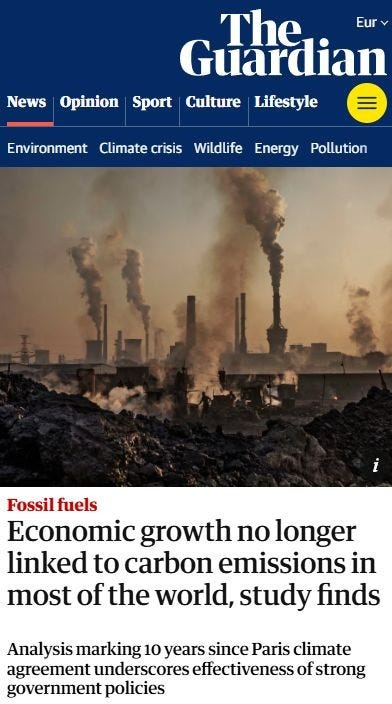
I was therefore quite surprised last week when I saw a headline in The Guardian that read:
“Economic growth no longer linked to carbon emissions in most of the world, study finds.”
I did a double take. I knew that statement was not true. At best it was misleading. At worst it was a lie. Carbon emission growth may have slowed in some countries, but it is still very much linked to growth.
The Guardian article goes on to talk about decoupling. Economists and environmentalists often talk about economies being “decoupled” from carbon emissions (or more broadly GHG emissions). This type of decoupling is becoming a linguistic minefield in the sustainability world.
Decoupling means - separating two or more interconnected systems so that they operate independently. That means there is no longer any relationship between the two variables.
True decoupling of economic growth from carbon emissions would mean that economic growth no longer has anything to do with carbon emissions. That is clearly not where we are.
But the report the Guardian wrote about - and the headline they ran, give people hope that the problem has been solved. The reality is that the relationship between growth and carbon emissions has only diminished some.
How much is some?
Not very much, and certainly nothing we could legitimately call “decoupled”.
What the data says:
Here are the claims about decoupling that have been made.
Countries representing 92% of the global economy have now decoupled consumption-based carbon emissions and GDP expansion, according to the report by the Energy and Climate Intelligence Unit (ECIU).
An earlier analysis, by the ECIU shows that the growth of annual CO2 emissions has slowed to 1.2% since 2015, compared with 18.4% in the decade before the Paris agreement.
To be fair, reducing carbon emissions is good. It isn’t nothing. But notice how the only emissions talked about are “consumption based carbon emissions”. These are emissions from fossil fuels and industry, but not land-use changes, deforestation, soils and vegetation - which needs to be addressed. More importantly, slowing something, or weakening a causal relationship is not decoupling.
There was a great analysis of the article by Matt Tutt over on LinkedIn that I encourage you to check out. He is more generous than I am, but comes to a similar conclusion that the content of the report, does not live up to the headline:
In their report they are claiming that decoupling is taking place - this is where economic growth is happening whilst carbon emissions are reducing. Absolute decoupling is when this takes place but relative decoupling is when economic growth outpaces carbon emissions (it’s important to note that these emissions can still be very very high... so “relative decoupling” isn’t actually all that great).
From the report data approx 50% of the countries reported on show absolute decoupling, and 50% show relative decoupling.
The problem is - decoupling can’t happen at the speed and scale that is required to bring our global emissions down enough. So, even if it is apparently happening in some countries - it won’t be enough to bring our emissions down to the 1.5~ degree window we need.
I don’t think articles like this help anyone because, like most “green growth” initiatives, they never get to the root of the issue (capitalism, imperialism, to name a few of those structural issues) and instead they continue to push this utopian “green growth” agenda.
Is Decoupling Possible?
A 2019 European Environmental Bureau paper reviewed the empirical and theoretical literature on the reality of decoupling and came to the conclusion that there was no empirical evidence supporting the existence of decoupling of economic growth from environmental pressures on the scale needed to avoid environmental breakdown and that such decoupling seems unlikely in the time frame needed to avoid the worst of climate change. The authors of the report identify seven reasons why the hypothesis of decoupling fossil energy use from economic growth often fails.
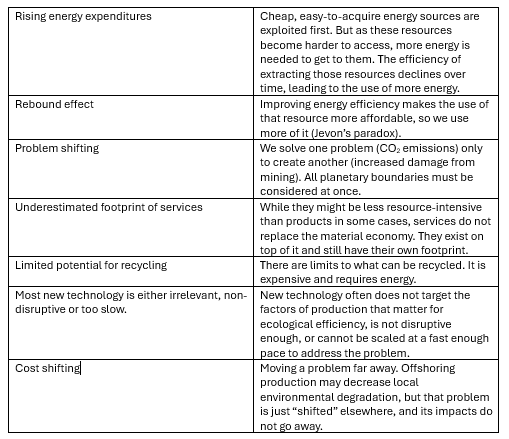
The authors note that from 1970 to 2010, the total material use at the global level has more than tripled (Schandl et al., 2018), and the material intensity of GDP per capita has increased by 60% between 1900 and 2009 (Bithas and Kalimeris, 2018). So even if carbon emissions and GDP could be decoupled, we currently have no reason to believe that material use and GDP could diverge.
Is decoupling possible?
Here is a graphic that shows some decoupling of CO2 and GDP up to 2020 - but relatively no decoupling from the use of materials (The blue line).
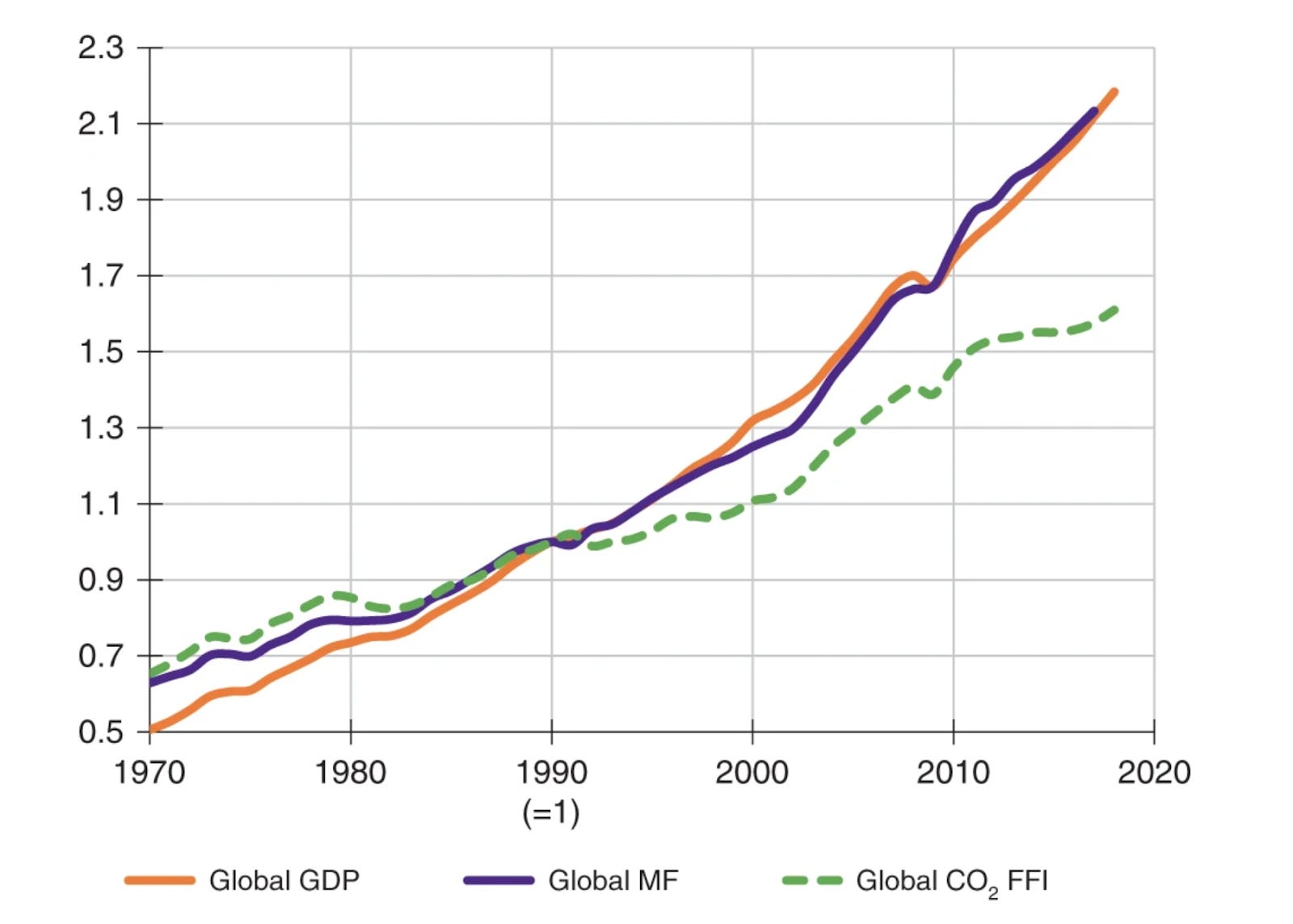
Source: Wiedmann et al. (2020). Scientists’ warning on affluence. Nature Communications (11)
The title of an article from the International Energy Agency (IEA) in January 2024 says it best. The relationship between growth in GDP and CO2 has loosened; it needs to be cut completely.
Degrowth is the Answer
I think the Guardian headline was irresponsible, and I’m disappointed that they put that out there. That headline gives people false hope. The Guardian should know better. But the Guardian overall does excellent work in this area, so I’m not going to boycott them or tell anyone else to do so.
There is no magic technology that is going to solve this.
Degrowth is the answer.
We need to understand that the idea that economic growth is our reason for being is false, ridiculous and self-destructive. Living life is our reason for being. The blind pursuit of economic growth at all costs is destroying our capacity to simply live.
Hope that humanity uses their critical thinking to eventually accept our predicament and deal with it.
Hoping that an economic fantasy of everlasting economic growth can be sustained is not only untrue, believing it is true is harmful.
Don’t give people false hope.
Give them the truth.
They can handle it.
Unfortunately, your esteem for The Guardian is somewhat past its Best Before date.
It has reduced itself to a supine servant of the establishment, playing the part of hard hitting, lefty analysts and using the inertia of its formerly deserved reputation for actual journalism. They're doing a BBC, basically.
See here: https://www.declassifieduk.org/how-the-uk-security-services-neutralised-the-countrys-leading-liberal-newspaper/
Whilst that speaks to non-climate subject areas, I think it gives light to what has happened to the core of the old rag.
Decoupling is a symptom of degrowth. Don't fight good news.
If you prefer a study that includes land use, this one was from 5 years ago and included several: https://eprints.whiterose.ac.uk/id/eprint/159384/1/Haberl%2Bet%2Bal_%202020%20_Environ._Res._Lett._10.1088_1748-9326_ab842a.pdf
How relevant is hard to say as some reports, like the Netherlands measuring all emissions, note: "Our report shows the Netherlands achieved absolute decoupling of production-based GHG emissions from GDP growth (1990-2022) after adjusting for cyclical fluctuations, *****with non-CO2 gases like CH4 and N2O decoupling more strongly than CO2.***** Policies have reduced emission, but more effort is needed to meet climate goals."
https://www.rabobank.com/knowledge/d011460941-assessing-decoupling-of-greenhouse-gas-emissions-from-economic-activity-in-the-netherlands-a-1990-2022-analysis
They're based on consumption based economy explicitly to avoid comparing the the finance economy (which is already decoupled, in another way, from consumption and manufacturing) which takes up a larger and larger fraction of many developed economies. Otherwise the results would look even better!