
Escape From Capitalism
Apparently there is a guide for that.

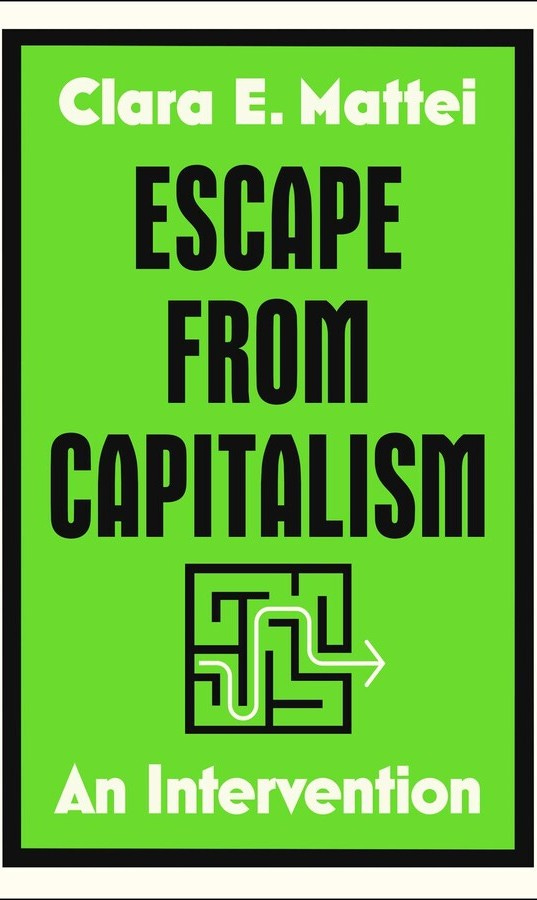
Another book came out recently imagining a world without capitalism, or at least what a world without our current flavor of capitalism might look like. In her recently released book, Escape from Capitalism, economist Clara Mattei argues that “It is time to demand an economic system that does not flourish at the expense of humanity.”
Seems reasonable to me.
Mattei is an economics professor at the University of Tulsa and the founder of the Forum for Real Economic Emancipation (FREE). If you are interested, you can find Free on Substack here: FREE | Substack
Mattei argues that capitalism isn’t the natural order of things and we shouldn’t treat it as though it is. If you do the math, capitalism has only been around for about 0.1% of the time humans have been on the planet. She asserts that capitalism requires constant violent enforcement of austerity to keep the system in place. She defines austerity as a set of economic policies that involve cuts to wages, fiscal spending, and public benefits as a means to achieve solvency. Mattei says that austerity is not just about managing budgets and debt but also about protecting capital and capitalism in times of social upheaval. She traces the origins of austerity to interwar Britain and Italy, where it was used to elevate owners and smother workers, imposing a rigid economic hierarchy across societies.
Mattei argues that the state needs to protect the market by keeping the majority of us subordinated to the system. We have no alternative but to sell our labor for a wage so we can have the things we need to keep up with the system.
She identifies two pillars of capitalism:
Wage labor - we have no option but to sell our labor for a wage. We produce much more value than what we get in our paycheck, but the systems serves capital - shareholders somewhere else who get most of the value.
Private investment - We have delegated to the owners of capital what gets produced and why. The reason something is produced is not necessarily human need or wellbeing, but what is the most profitable. If that doesn’t help humans, or even harms them - who cares - it is profitable, which is always good. The assumption is that nothing would ever be produced unless it was profitable.
Austerity is built into the system. It keeps us desperate. Austerity is a necessity of the capitalist system, to ensure that people need to sell their labor in order to just get by in the world. Austerity isn’t such a natural necessity. Austerity is political.
It isn’t human nature to ONLY dominate your fellow man for profit. Humanity has no innate need to be capitalist. We have just adapted this way under a market system. Things could have gone very differently. No doubt things will be very different a few hundred years from now. Our environment will change. We will adapt. We will likely have more cooperative communities because of that.
We can be different depending on the social interactions we construct. Caring for the commons. Caring for nature instead of extraction. In Tulsa the forum for economic emancipation. Start at the local level, associate through assemblies and grow power to put pressure on state and national governments. These choices have been made by the elite with the masses having very little power.
This capital order is imposed globally.
Capitalism benefits b/c it is the story we are telling ourselves. If you are on the bottom you deserve it. Those at the top are just better than you. Let’s take back our relationship with each other. Our governments are there to protect capitalism, not to serve you.
We built it - so we can change it.
Mattei recommends a shift towards what she calls humanistic socialism that prioritizes meaningful work and just compensation over the profit maximization of capitalism. She argues that capitalism and democracy are incompatible because democracy requires workers to have agency, which capitalism looks to take away
Mattei sees academia as too elitist and argues for getting on the ground and getting things done - which is why she started FREE. She argues for more participatory democracy. Participatory budgeting, factory councils, and neighborhood councils are examples.
I’d recommend giving it a read if you are so inclined. The book clocks in at a little over 200 pages, so don’t be intimidated. It is a great companion piece to Andy Hines’ Imagining After Capitalism that I recommended last year, which talks less about the flaws of the capitalist system, but gets to work imagining what comes next.
I’d like to see Clara and Andy on a panel or an interview show with Clara laying out the shortcomings of our current system and then Andy telling the audience about what might come next.
Both books do the important work of giving people permission to imagine a different system than the one we are told is inevitable but is trying its hardest to collapse.
Ha, yes, I did take notes and wanted to give a bit of a summary of what the reader would get. Guilty. Yes, I've followed Nate for a while and enjoy the great simplification. He does great work. More people should tune in to him.
Austerity cannot ever work because of basic accounting identities: a deficit in the government sector means that the non-government sector is in surplus and attempting to run a government surplus forces the non-government sector into debt. This is why George Osbourne had to use Quantitive Easing to inject more money into the UK economy after initiating austerity in 2010.
Richard Murphy's blog site has an excellent summary of the nonsense of austerity:
https://www.taxresearch.org.uk/Blog/glossary/#austerity
And anyway the problem isn't just capitalism, it's the reliance on exchange logic in general. We need to move to a system of mutual aid and interdependence, grounded in bioregions rather than nation-states.