
Everyone Gets a Unicorn
The Global Justice Report


Photo by June Gathercole on Unsplash
The Global Justice Project recently released The Global Justice Report - which aims to set an ambitious vision for what could be if humanity gets its collective act together. The report was published by the World Inequality Lab and was coauthored by a team of global economists including Lucas Chancel, Thomas Piketty, Gabriel Zucman, and Emmanuel Saez.
The report imagines the conditions under which humanity might turn things around if we decided to address the polycrisis (climate change, overshoot, inequality, etc.). The paper starts at the status quo and imagines what is possible by 2100.
Warning, there is some wild-eyed optimism here.
The report concludes that it is possible to reconcile planetary habitability and high well-being for all mankind. But there is a catch. To achieve this we would need to transform three systems (the report calls these pillars) simultaneously.
Rapid decarbonization of energy systems.
A shift toward sufficiency - a sharp reduction in labour hours and material footprint.
A drastic reduction in inequality of income, wealth and power.
Simple.
More Detail
The authors of The Global Justice Report combine four dimensions of the changes needed - arguing that they need to happen at the same time to reinforce each other.
redistribution at the world scale,
a deep reform of the international financial and economic order,
a radical transformation of energy systems
substantial shifts in consumption patterns.
Simple.
The authors note that per capita monthly national incomes converges to €5,000 in every country in their model. The share of the bottom half of global wealth increases from 2% to 30%, while the share of the billionaire class decreases from 6% to 0.05%. Under this scenario, nearly 90% of the world’s population double their income while working roughly half as many hours as they do today.
Climate change is mitigated under this scenario as well. The report shows that if the actions suggested are taken, warming reaches 1.8°C by 2100, rather than over 4°C under business as usual.
The Global Justice Project aims to place these proposals within a quantified institutional framework, which models socioeconomic convergence, temperature change, and distributional trajectories through 2100 to show how we can actually save ourselves if we choose to do so.
Everyone Gets a Unicorn
The report is great in that it shows what is theoretically possible. But I think it is dangerous because it shows what is theoretically possible.
It is theoretically possible that everyone reading this will win the lottery today.
While I read through the report, I couldn’t help but wonder if they had enough cynics and pessimists in the room while it was being written. If the authors are interested, I know some of these people they might want to talk to.
Let’s look at the report’s claims that global wealth and income taxes can raise the resources needed by the Global Justice Fund and to curb the concentration of income, wealth, and power at the top of the world distribution. Country-level policies (progressive taxation, minimum wages, pay-scale regulations, labour market rules, workers’ representation on corporate boards) are expected to play the leading role in reshaping each country’s income distribution in the long run. Here is the graphic from the report that shows how this will work.
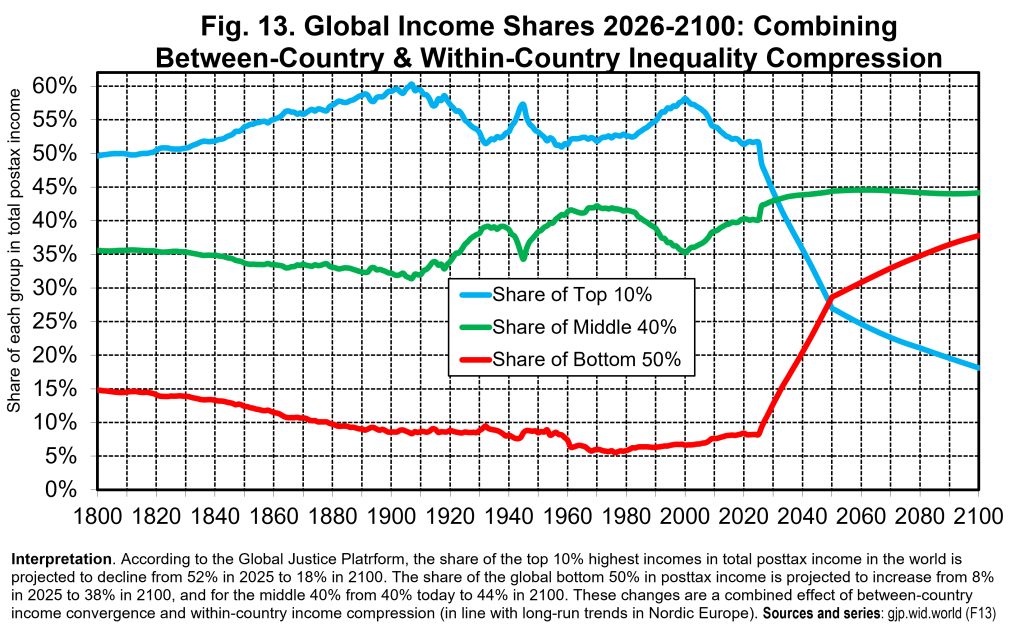
The graphic shows that we need to tax the 10% into oblivion starting tomorrow - across the whole planet in order to fund global wealth distribution.
I just don’t know a world where anything close to that will be possible, maybe ever - much less tomorrow.
The Global Justice Fund
The report proposes the creation of the Global Justice Fund (GJF), which is part of a broader transformation and democratization of the international economic and monetary system. The GJF would be a new international institution, with budgetary decisions taken under a double-majority rule: 55% of countries representing 60% of the world’s population.
This body is meant to replace institutions like the IMF and World Bank. The GDP-based voting at these institutions gives Europe & North America/Oceania roughly four times their share of the world population.
Would it be nice to replace the World Bank and IMF? Yes. These institutions are largely run by and for the developed world and do not serve - and are not meant to serve most of humanity.
But simply saying “we will have something better” without laying out how we get there is a bit of an everyone gets a unicorn scenario.
Let’s walk through why it is difficult to just toss away the IMF.
The IMF is a lender of last resort for many countries, including many emerging markets. Without it, countries in crises would lack access to emergency financing, increasing the risk of debt defaults and financial instability.
The IMF’s data is used by investors to assess creditworthiness. Removing it would erode trust in global financial markets
The IMF works alongside the World Bank, the G20, and other institutions. Disbanding it would require dismantling these interconnected systems, which is politically and economically impractical.
You can say, F*&# the IMF, let’s blow up the system. That’s fine. But if you blow up the IMF on Monday, you have to know what to do on Tuesday when the world realizes the IMF is gone. Then you have to have a way for countries in the Global South to get the money they need in a crisis, for the global financial system to still work.
You may not want a global financial system, but you have one. Throwing it away would be very destructive. Again, you can do that. But that will not go smoothly, and you won’t have the nice smooth “transition” curves we see in this report.
I think the IMF, World Bank and other institutions can evolve into something like the Global Justice Fund. But it is more likely that the financial world goes through a catastrophic crash and something like the Global Justice Fund is built from the wreckage. That will not be as smooth and seamless as the report suggests.
The phrase “everyone gets a unicorn” is a way to say that everyone gets an extraordinary and magical thing, or more simply - a thing that does not and cannot exist. An example would be a world in which every world leader decides to do the right thing tomorrow, when they have been fighting like hell to not do that over the past fifty years.
This will not happen and to suggest it is within reach is dangerous.
In addition to some of the items I already mentioned, here is a list of some of the things the report says are possible:
Equality between countries: Average per capita monthly gross national income (PPP Euros 2025) rises to 5,000 Euros in all countries by 2100. Today, it ranges from 290 Euros in Sub-Saharan Africa to 4,590 Euros in North America/Oceania (a 16-fold gap).
Less work, more emancipation: Annual labour hours per employed person fall from about 2,100 hours today to about 1,000 hours by 2100, continuing the historical trend toward shorter working time.
Education and health for all: Per capita education spending rises to 8,400 Euros per year across all countries in 2100. Today, it ranges from 210 to 4,140 Euros. Health spending rises to 14,400 euros. Today it ranges from 110 Euros to 8,300 Euros. The share of global working hours devoted to education and health rises from 11% today to 43% in 2100.
Full gender equality: Women and men converge on equal amounts of economic and domestic labour and on equal average pay.
A world below 2 °C: Warming reaches 1.8°C under sustainable convergence and fast decarbonization, against over 4°C under persistent inequality and slow decarbonization (current policies).
Inequality compression: The income scale is compressed to 1 to 5, and the wealth scale to 1 to 10. This represents a major compression of global income inequality, on a scale similar to the reduction achieved in Western and Nordic Europe over the 20th century.
Wealth redistribution: The bottom 50% global wealth share rises from 2% to 30% (×15), while the top 0.001% share (billionaire class) falls from 6% to 0.05 % (÷100) – a striking redistribution.
Global Justice Fund: Annual expenditures (including country dividends and investment flows) reach 10.3 % of world GDP per year on average over the 2026-2060 period. In comparison, current official development aid and the combined budgets of the UN, IMF, and World Bank account for less than 0.4% of world GDP. This is justified by the fact that new climate investments alone will represent 3-4% of world GDP per year in the coming decades and will need to be supplemented by a big push in education and health expenditures to foster global convergence.
World Sovereign Fund: An active portfolio of sustainable assets reaching 10% of the world capital stock (or equivalently, to 60% of the world GDP). Initial asset accumulation comes from reinvesting a large part of global wealth and income tax revenues over the 2026-2035 period.
Global wealth & income taxes: A global wealth tax (rising from 0% at 10 times the world average wealth to 20% per year on billionaires) and a global income tax (rising to 90% at the very top), both targeting around 1% of the world population.
Large majority benefit in every region: About 89% of the world will double their monetary income between 2026 and 2100; over 95% gain in the global South, and between 85–95% in the global North. Over 99% of the population is better off when the valuation of leisure and planetary habitability is included.
From global plutocracy to global democracy: All inhabitants of the world have equal political voice in the Global Justice Fund and the new international order. Currently, Europe & North America/Oceania have 4x as many votes at the IMF and World Bank as their population share, while Sub-Saharan Africa and South & South-East Asia have 4x fewer votes than their population share.
End of exorbitant privileges: The creation of an International Clearing Union and a new international currency to put an end to exorbitant privileges, i.e. the fact that rich countries benefit from higher returns on their foreign assets than what they pay on their foreign debt, thereby receiving a financial transfer from poor countries (0.6-0.8% of world GDP per year on average over 2000-2025 period, about twice as much as total development aid).
Come join us over here in reality when you are ready.
I think the authors of The Global Justice Report did good work. What they suggest is possible is a worthy aspiration. But it will not happen. I have seen people tripping over themselves to praise the report since it came out. But what is in the report will never happen.
Those things won’t happen through government action or altruism. If that was possible, those things would have already happened … somewhere. But they have not. An end of exorbitant privilege, a shift from plutocracy to democracy, inequality compression and gender parity don’t happen with the stroke of a pen. They happen after a collapse. They happen after a revolution.
What is coming is a collapse. It has already started.
There are no unicorns in our future. We shouldn’t pretend that there will be. People will want to believe in unicorns if you tell them that everyone gets a unicorn. When in reality, no one ends up getting a unicorn - people will give up.
Tell people that the future will be hard, but that if we build a strong community we can get through it together. Don’t sell them a fantasy.
I like to hedge my bets. I also operate by the motto, “hope for the best and prepare for the worst”. Degrowth seems the most realistic approach. We need to seek “sufficiency” rather than “sustainability” as the latter suggests we can go on as we are doing. Many of us are working hard on these very things. But, I also recognize that “without a vision, the people perish.” This piece by Piketty, et. al. provides an opening. Let’s fill it with a vision grounded in biodiversity promotion and community.
I am more of a grizzled, than a wild-eyed, optimist.
But I am still an optimist.
We can get to Degrowth by design. There is still time.
And we don’t need a futuristic Global Justice Fund.
The existing Mid-Century Modern social innovation of the Workforce Pension will work just fine.
Tens of trillions have been aggregated since the middle of the 20th Century into social trusts for workforce pensions, collectively, worldwide.
Pensions are already planetary in scale.
They have always been planetary in responsibility.
But we do have to do some updating.
The design of the pension requires prudence in the exercise of capacity derived from character under the circumstances then prevailing, in undivided loyalty to aims.
The last time we considered the capacity of pension was in the early 1970s. A lot has changed since then.