
EY Extractivism Report
Pass it around.

Last month, EY’s Global New Economy Unit (NEU) published the report titled “From extractivism to regeneration”, co-authored by Anastasia Roussou and Nadia Woodhouse, with input from post-growth luminaries like Hans Stegeman and Tim Jackson (check the acknowledgments in the paper for more).
The paper offers a strong critique of the extractivism embedded in our current economic system.
The authors define extractivism as:
A form of excessive extraction that privatizes gains for a minority while socializing costs, particularly when this activity exceeds planetary and social boundaries. Extractivism is distinguished from necessary extraction by its scale and impact, and is characterized by the tendency of businesses to prioritize short-term financial gains at the expense of social and ecological well-being.
Before we go any further, I want to point out that the EY that put this report out is the EY you are thinking of. They are a global accounting and consulting firm that has offices in 150 countries and employs about 400,000 people around the world. Most everyone reading this probably knows someone working at EY. They are huge.
This is the third report from NEU. The first was Regenerative principles to unlock a sustainable future that I wrote about here two years ago when talking about how degrowth was going mainstream.
It is a big deal that this report, critical of extractivism, is coming from inside the house of the global corporate establishment - and arguing for systemic structural change. If you are so inclined, please reach out to the authors (linked above) thanking them and asking how you can help spread the word.
The Core Argument
The report frames extractivism as something far more prevalent in our economy than we realize. Extractivism doesn’t just involve taking minerals out of the ground. The authors invite us to think of a platform harvesting our data, or a landlord letting a building rot while rents rise, or a supply chain priced on wages nobody could live on - as examples of extraction as well. In the end the same forces are in action: privatize what earns a return and socialize what costs. Whatever earns a return is pursued and celebrated, anything else (costs) are externalized.
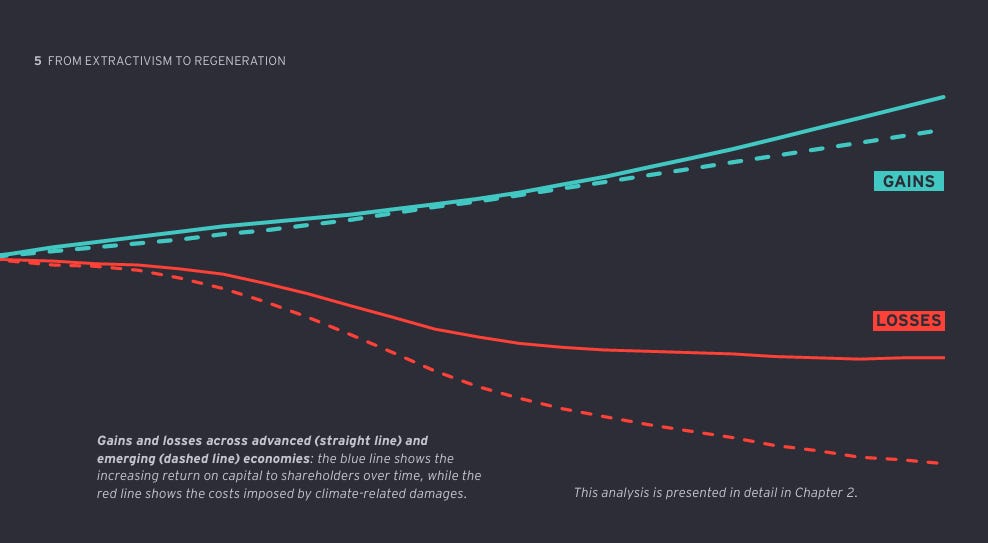
The NEU put some numbers to the story to help us better see what has happened.
🟪 Since 2000, G7 dividends grew three times faster than wages, twice as fast as corporate tax.
🟪Welfare losses from inequality up 45%.
🟪Biodiversity costs up 60%.
The logic behind these extractive actions are embedded into our legal, political, economic and cultural systems. These practices are often framed as the utilization of resources, or simply the pursuit of innovation and strategic planning. But this goes too far when extraction has no limit and excess gains come at the expense of the environment and society. The authors warn that true sustainability efforts that seek to counterbalance or reverse this dynamic (like degrowth) are often met with resistance, as incentive schemes, legal structures, and market and social norms contribute to system inertia.
Concepts such as shareholder primacy, short-termism, perverse incentives and a flawed interpretation of fiduciary duty always put profit over people - as extractivism is built into our legal systems, regulation and tax codes.
Evidence of Extractivism
The authors offer the evidence of extractivism through a comparison of gains and losses we have seen in recent decades (their base year was 2000).
Indicators of gains include:
■ Dividends received by households from the distributed income of corporations
■ Employee compensation, including wages and non-salary benefits
■ Taxes paid out by corporations to governments.
Indicators of losses include:
■ Climate-related damages (modeled using global climate-related damages)
■ Biodiversity losses (modeled using the Living Planet Index)
■ Welfare losses associated with social inequality (modeled using the Atkinson index of inequality).
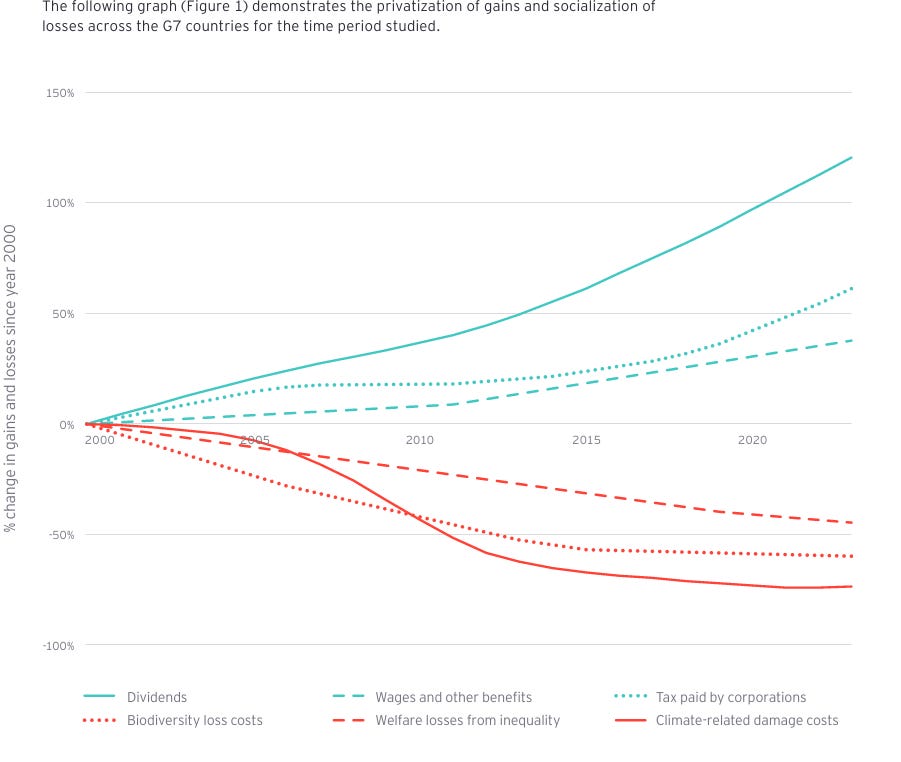
The gap between financial gains and environmental losses is widening across G7 economies, according to the authors.
How to Fix This
The best part of the paper is chapter 4 - Pathways to regeneration. It is here that the authors describe the steps we can take to reorganize our economies to be less extractive. The aim is to help businesses identify ways to shift their businesses to focus on sufficiency, increase circularity, to redefine value and use systems thinking to arrive at an economic model more focused on equity and justice.
The authors do this by providing a list of changes we can make as a society to move away from an economy based on extraction. I’ve reproduced this list below to give you an idea of things to focus on, but the report goes into far more detail - most importantly, providing examples where these ideas have been implemented. In the report each example given below is accompanied by a description of how that change was carried out - often with multiple examples from multiple jurisdictions. In essence chapter 4 is a playbook on how to get started fighting against the extractive economy we are trapped in.
Regulatory reform
Legal recognition of mission-locked stakeholder-centric businesses
Enshrining purpose beyond profit into corporate governance and accountability
Industry standards around resource and labor, including bans on harmful activities and outcomes-based requirements
Legal recognition of the Rights of Nature
Financial incentives and disincentives
State-backed transition finance mechanisms
Capital allocation politic that restrict excessive privatization of gains
Industry and consumer tax incentives
Corrective taxes on excess profits or unsustainable activities
R&D and innovation
Open knowledge, access, and interoperability frameworks
Benefit sharing frameworks
Supporting plural knowledge systems
International alignment
Trade and policy conditionality for regenerative outcomes
International adoption of ecological and social accounting including beyond GDP measures
Capital allocation
Public and blended finance to de-risk high impact projects
Preferential or conditional lending for regeneration
Sustainability-integrated finance and decision-making
Market infrastructure and risk
Mandatory, standardized stress-testing including climate and nature for banks and insurers
Scale-up and harmonization of carbon and biodiversity markets
Long-term capital infrastructure
Strengthened and consistently adopted standards and disclosure frameworks.
Awareness and capacity building
Training programs for citizens, farmers and entrepreneurs in regenerative methods
Fostering transparency around company ownership and governance
Updating curricula for business schools to design regenerative organizations
Citizen participation
Mandatory youth participation
Participatory budgeting
Citizen assemblies
Community-led initiatives
Creation of solidarity networks on topics of radical democracy, energy, food and agriculture and health.
Climate change litigation
Cooperative community initiatives to provide access to basic services
Multi-stakeholder platforms and networks
Global alliances of institutional investors and stewardship networks
Multi-actor partnerships for regenerative systems
Going forward
The paper ends with the authors asking its readers to act in order to shape the transition we need and advocating for and helping to create the conditions where these suggested changes can be implemented.
It says something that one of the world’s largest consulting firms feels the need to write a paper openly challenging the current economic operating system. They would not be doing so if there wasn’t an audience out there wanting to hear this message. This paper is another brick in the wall of building a permission structure for companies to step away from the self-destructive model that is our current global economic system.
Read the paper yourself, and make that audience larger by sharing it with those you feel should read it - especially business leaders who are its main audience. If one of the largest consulting firms in the world is looking to advance post-growth thinning, maybe there is hope yet.
I would like to think EY were really behind this thinking but my concern is that this is making them look good without actually providing a way for businesses to move to less extractive practices that doesn't put them at a competitive disadvantage.
It is certainly a step forward for such an organisation even to be talking about this let alone stating the situation is such bald terms. I hope I'm wrong and this is a genuine attempt to steer practice to more sustainable pathways. It will be interesting to know what effect this report has on political debate and whether any companies declare their intention to make the move.
Thanks for highlighting this development as it I am pretty sure it won't be making the evening news!