
Moving Beyond Capitalism
There's the beginnings of a plan ...

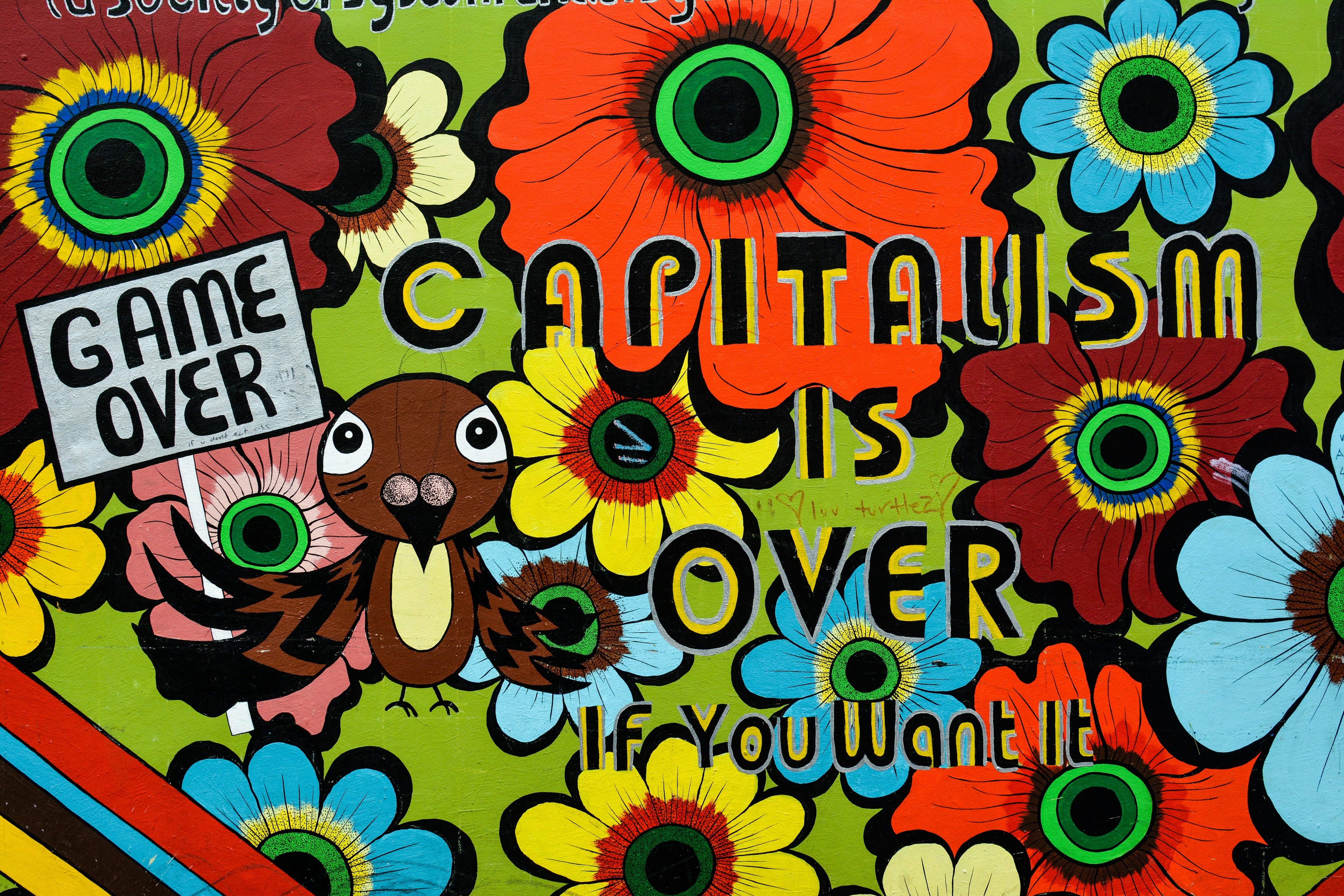
Photo by Koushik Chowdavarapu on Unsplash
Over the past few months, I’ve been writing about what a post-growth world might look like and how to get there when I see someone writing about it.
Here are the links to some of those in case you missed them, or are new here:
Bioregionalism As Our Economic System - by Matt Orsagh
What a Post-Growth Future Could Be - by Matt Orsagh
Scotland Blazes a Post-Growth Trail - by Matt Orsagh
People Love Degrowth Policies - by Matt Orsagh
There is more, deeper in the archives (see for yourself), but those are four of the most recent ones. Part of what I want to do here in this space is to get people to see that there are ideas out there, and in some cases, actions already being taken to transition to a post-growth world.
Well, there is another entry or the “ideas to move to a post-growth world” file. On February 12th, the Guardian published an article titled; “We can move beyond the capitalist model and save the climate - here are the first three steps.” The article was co-written by degrowth leader Jason Hickel and Greek economist and politician Yanis Varoufakis.
Hickel and Varoufakis state plainly that capitalism is incapable of addressing the social and ecological crisis we face. We can’t count on capitalist systems to fix this, because they were designed to exploit and finance growth. Caring about what happens to people and the planet isn’t part of the capitalist model.
Hickel and Varoufakis claim that capitalism is run by a tiny minority that controls the capital, and they determine what to produce, how to use labor and who benefits. The people who are actually doing the production get no say. Our democratic institutions are servants to growth and therefore captured by the system. This results in the overproduction of things we don’t need so that capital gets a return on investment.
What do they propose?
Here are the three things they propose to start with to move beyond capitalism:
A new financial architecture that penalizes destructive private “investments” and enables public finance for public purposes. They propose a new public investment bank that converts available liquidity into the types of investment consistent with common, sustainable prosperity.
The extensive use of deliberative democracy to decide sectoral, regional and national goals towards which new public finance tools will be aimed.
A Great Corporate Reform Act for the purposes of democratizing corporations, favoring and promoting the formation of companies run along the lines of one employee, one share, one vote.
That’s a good start.
That’s a fine start, but that first one is a bear. Remake finance so it better serves people and the planet is a big lift - but that is why I helped found Arketa Institute - to do just that. We’ve written on why finance needs to change and how to reform the pension system.
There are increasingly more people in the financial world interested in this project, so if you are interested in that, reach out to me, or other groups that are doing similar work. We started Arketa Institute about a year and a half ago, and at that time, there was very little movement in the financial world on degrowth. That’s understandable, as a post-growth world would mean less need for finance, and the people in that industry don’t want to give up their wealth or their status. But we have seen interest grow, especially from young people who understand what is going on and know that they have to change the system if they want one that works for them.
One of the main obstacles in the finance space is the concept of “fiduciary duty” - or acting in the best interests of clients or shareholders. That has traditionally been narrowly interpreted to just mean monetary returns - assets going up in value. However, more financial professionals are realizing that if the world burns, their money will have no value - so momentum for change is growing.
The deliberative democracy angle is interesting. More people are seeing that our democratic systems don’t work for them, don’t represent them and don’t care about them. I have written about that here and here, but there is a lot more out there on this front. If you have the chance to engage in deliberative democracy where you are, or to introduce the concept in your town, please do so.
That last idea of reforming corporations is another huge lift but gets a little easier each day with things like further revelations from the Epstein files and clear and present evidence that the billionaire class is out for themselves.
Please weigh in.
Hickel and Varoufakis are off to a good start.
I would add a push for degrowth policies such as a four-day work week, universal basic income, universal basic services, a job guarantee, and laws dealing with issues such as planned obsolescence, the right to repair, and regulations to allow communities to become more autonomous in their agriculture and power generation. I’d like to see more governance at the bioregional level so that the physical assets (water, air, soil) that keep us alive are controlled more by the people who live within those resources and not governments far away that are beholden to growth. But that’s just me.
But I’m interested in what you have to say. What would you add to this list? How do we go about changing finance, democracy and corporations to better suit us and not just capital?
Share your thoughts.
Degrowth is coming whether or not anybody wants it. The specific criticisms of capitalism are in fact criticisms of humans Limited cognitive capacity driven by selection pressure. Our planning time Horizon is 50 to 100 years maximum. Unfortunately all the problems of today were hundreds of years in the making and will require hundreds or thousands of years to resolve. What we have today is more accurately called short form capitalism that reflects the limited time planning Horizon of humans. What you need is long form capitalism which fully accounts for the consequence Loop. Society will move much slower innovation will be incremental. That's the trade off. And that has be a conscious decision from every person on the planet that we are not going to go head first into the maximum power principle.
What troubles me about the claim that finance reform is the necessary first step toward degrowth or post-growth is that it seems to concede quite a lot at the outset. It treats finance as a legitimate base layer of social coordination, and assumes the task is to redirect it toward better outcomes. I understand the practical appeal of that, because it provides handles that existing institutions can easily grasp, but I am not sure it fully captures what finance is doing socially. Describing finance as a way of converting liquidity into investment may explain an operational function, yet it leaves out the extent to which finance also organizes enforceable claims over the future. Finance structures access, allocates risk, disciplines behavior, and concentrates decision-making power in institutions built on abstraction. If that is part of its core role, then preserving finance as the starting point risks preserving the grammar of domination itself.
So the logic feels inverted to me. A politics that claims to move beyond growth should be careful about beginning with the reaffirmation of institutions that made abstract accumulation and hierarchical allocation possible in the first place. Reforming finance may soften some harms, but it can also leave intact the machinery through which social life ismade legible to power. In that sense, it will likely end up treating specific choke points as inevitable, and then proposing to regulate it more ethically. That may be an improvement, but it is not necessarily transformation.
We also have ample historical precedent showing that complex human societies have coordinated provisioning, obligation, and long-term stewardship through commons, reciprocity, customary systems, mutual aid, guilds, communal storage, and federated forms of cooperation without finance acting as the sovereign layer. These arrangements were imperfect, but they demonstrate that monetized and financialized coordination is not a civilizational necessity. So the functional layer of finance isn't actually necessary unless we are deliberately including the very institutions that have led us to requiring change.
And our modern technological capacities make the old justification even weaker. Distributed communication, real-time data sharing, participatory planning tools, ecological monitoring, and networked logistics give us a massive ability to coordinate more directly than most past societies ever had. If earlier communities could organize life without finance under much tighter informational constraints, then surely we should at least be willing to ask whether finance needs to remain central at all.
So my objection is not simply that finance reform is inadequate. It is that it may begin from the wrong premise. Rather than assuming finance must remain the first step, I think a serious post-growth politics should ask how dependence on finance can be reduced from the outset, and what forms of coordination could begin to make it less necessary.