
What Are Data Centers For?
For accelerating collapse ... for profit.

A data center is just a warehouse where supercomputers, servers, networks and other tech wizardry are housed. Their purpose is to drive the AI revolution.
What is the purpose of AI? The sanitized definition is something like: “To make life easier for humanity, by solving issues that help people work efficiently.”
The real definition is: “To profit by convincing people, companies and governments that AI can solve all problems.” Like other technologies, such as the Internet and social media, AI will help make some things easier, while further eroding the social fabric of our society. Like the Internet and social media (which I use) AI makes it easier to get through life without physical interactions with other people - they are the very things we were programmed over tens of thousands of years to do - to need to do. We are less happy when we don’t interact with our fellow humans. Our technologies are promising us that life is better without them.
The numbers.
The numbers behind the AI revolution are staggering.
As of March 2026, there are 4,011 data centers in the United States ahead of the UK (511), Germany (507), China (368), and France (344).
US data centers are responsible for about 4% of total US energy consumption and are projected to increase their energy needs by 133% by 2030.
US data centers use about 1.7 billion liters of water per day. That is about half of the current daily water use of New York City. By 2030, they will be using more water per day than New York City.
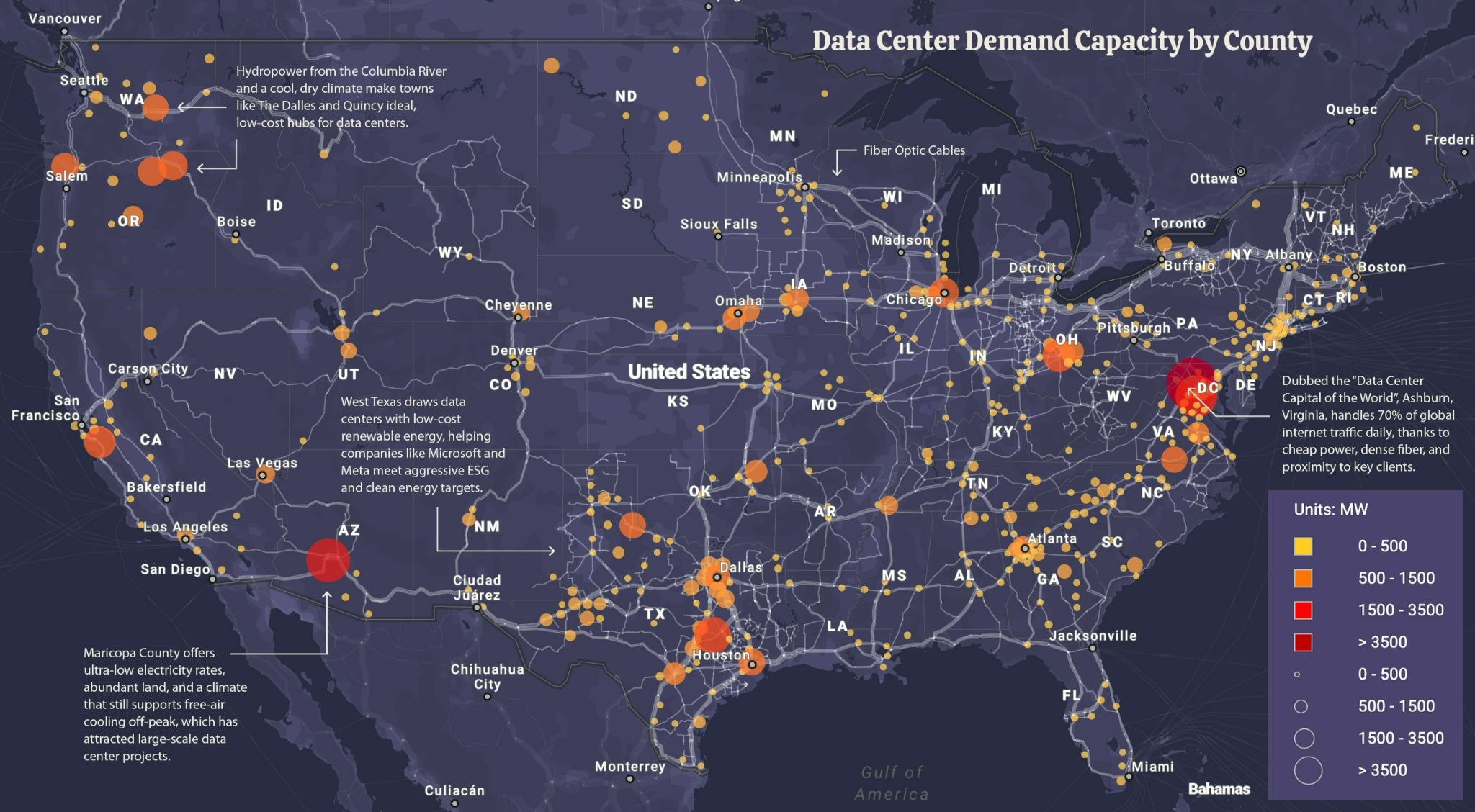
Image from The Visual Capitalist
Pushback.
It should come as no surprise then that communities are starting to question the wisdom of building more and more data centers.
You aren’t going to put a new mammoth data center in the middle of Chicago. Too many people would complain.
But you can build on in Memphis.
Elon Musk’s xAI “Colossus” data center in Memphis has highlighted the tradeoff from revenue brought in by a data center and the environmental damage it brings. The data center is powered by 35 methane gas turbines that produce 1,200 to 2,000 tons of nitrogen oxides each year, causing smog and respiratory issues.
When the data center was being built, Musk promised to cool it with recycled wastewater rather than drawing from the Memphis Sand Aquifer, which took millions of years to fill. The recycling water plan was scrapped, and now the aquifer is being used. The government in Memphis got a nice big check upfront, for poorer health outcomes now and in the future, inflated energy prices and the potential loss of their main water source in the future.
The data centers you see going up now require a lot of land, energy and water for cooling. That land is cheaper outside cities. The huge checks written by tech companies to build data centers are seen as a windfall for the primarily rural areas where populations are low, and even in decline.
But the tide has started to turn.
About 66% of residents in Port Washington, Wisconsin recently passed a referendum requiring the local government to get voter permission before signing up for any more data centers.
The State Senate in Virginia (where I live and which has the most data centers by far) has put forward a budget that would get rid of a sales tax exemption currently enjoyed by data centers.
In the past week, the governor of Main vetoed a bill that had passed the state legislature that would have put a moratorium on data centers above a certain size.
Expect more battles like these in the coming months and years.
The promise and the reality.
In theory, data centers exist to turbocharge growth through the increased use of AI that is promised to drive efficiencies and lower costs (mostly labor costs).
But the growth promised is not possible. The laws of thermodynamics, the eventual end of the AI stock crazze, and the simple fact that human beings need air to breath and water to drink will stop the current data center mania.
That means in reality, data centers exist to bring about their own destruction.
We are undoubtedly in an AI bubble. The revenues that would justify the unrealistically high valuations of companies related to AI, won’t materialize - if you still believe in reality. In stock market manias, like the tulip mania, the speculation that led to the great depression, the dot.com bubble, the housing bubble, and now the Ai bubble, reality always takes a back seat. But eventually, reality will take back the wheel.
Degrowth is the answer.
That the AI mania and the overproduction of data centers have gotten this far is a testament to the power or greed and marketing. Greed pushes us to prop up manias again and again. That greed can buy a whole lot of advertising.
If you pay attention to corporate media, financial media, or any of the media that comes through the devices on your phone or computer that comes from a company that has its hands in data centers, you might think that the public support AI and data centers.
They do not.
A recent survey from Pew Research Center, shows that Americans have consistently been more wary about AI than they are excited.
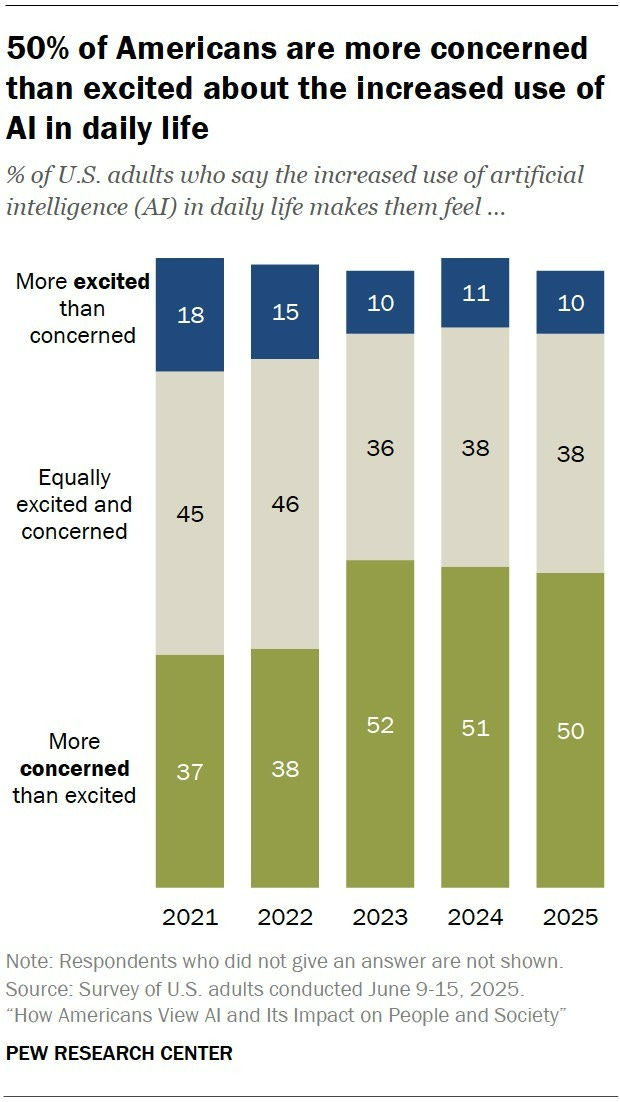
Maybe that’s because they don’t have stock options in AI companies and are instead concerned about preserving things like creativity and human relationships.
A rightsizing of AI is coming by disaster or design. When the data center bubble bursts, expect to see lots of data center plans cancelled and for current data centers turn back into warehouses, with their servers removed. Maybe the good people of Memphis can have clean air and water again.
The data center build out will speed up the collapse to come, by taking energy and water from human beings that need it, so that machines can replace the brain work of those very human beings.
A society that didn’t feel compelled to grow at all costs would see this as a ridiculously dangerous bargain, and never go down the data center road, and be much more deliberate and cautious about AI.
We don’t live in that world.
You left out the justice component. The city of Memphis will get revenues, while the mostly black residents of already heavily polluted Boxtown, downwind of the monstrous data center--some of which was illegally built without permits--will get the brunt of the air pollution.
Here in West Virginia, it doesn't matter what public opinion is, as the state legislature passed a bill last year taking all decision-making on data centers away from communities and local officials--initially the bill also reserved all the tax revenue for the state, until county commissioners went to Charleston and holed, and now the counties get 30% of the tax revenue along with 100% of the harms of data centers whose location is chosen by California billionaires with no need for ANY local buy-in. I get frustrated reading of the success of communities all over the country in fending these things off, because they lobby local officials or use zoning--and we have no rights to such things. Of course, this is just the latest episode in over a century of West Virginia politicians handing rights to our natural resources to anyone who wants to come in, rip out whatever has monetary value, take a big shit on us, and leave.
Not to mention what I think is the main purpose of AI, mass surveillance.