
What Does an Economy Without Growth Look Like?
Like this ...

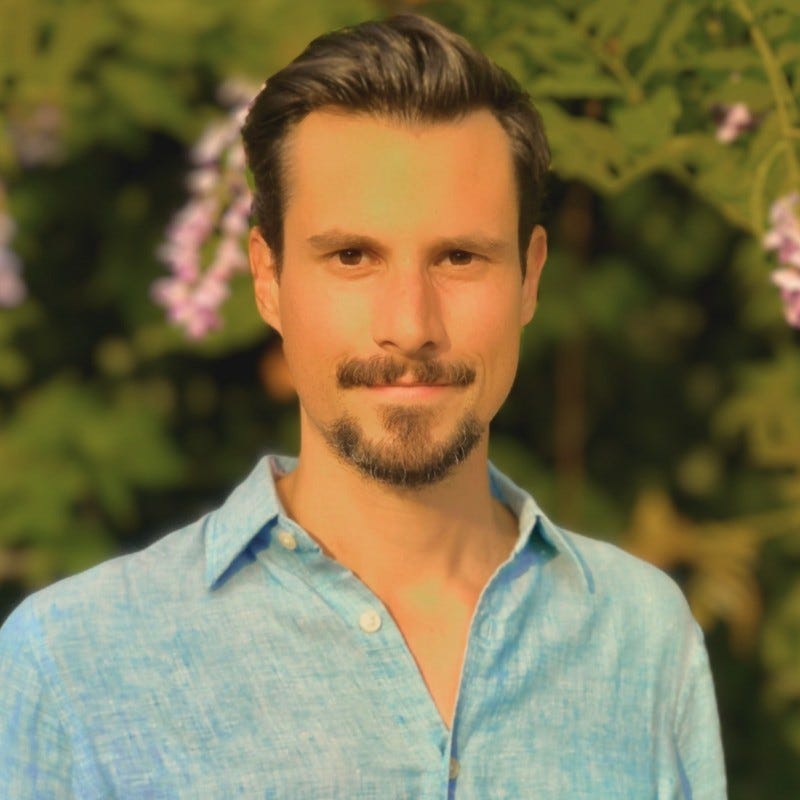
This is Riccardo Mastini. He’ll tell you what it can look like.
One of the main hurdles many people have with degrowth is imagining what it would look like in practice. Most of us live in societies where the pursuit of growth is taken for granted as an unquestioned good, if not a necessity.
With a little research we can see that this isn’t the case, and that the pursuit of endless economic growth has gotten us into some deep environmental and ecological trouble that we and future generations will pay a steep price for.
But even those who are pro-degrowth or at the very least, open to the conversation understandably would like to know what such a world would look like - simply because they have never seen one. It would be helpful to have an example for what to imagine, and what ideas to debate, so we can get on with this project.
Ask and you shall receive
I recently came across such an example in Riccardo Mastini’s paper A Green New Deal Beyond Growth for the EU.
Mastini opens his paper detailing the sense of dissatisfaction among EU citizens, with only 34 percent trusting their national governments, 1 in 5 at risk of poverty or social exclusion, and only 16% of habitats under the EU Nature directive in good health. The democratic, economic and ecological health of Europe is poor, and its citizens know it.
In this environment the European Commission has launched the European Green Deal (EGD); meant to unlock billions in sustainable investment, cut emissions and protect biodiversity. Mastini shows that the funds promised for the deal are unlikely to materialize in the amounts promised, which even if fully delivered would not be adequate to address the ecological, political and economic problems facing Europe. You tell me if he sounds optimistic:
The EGD provides, one might argue, a corporate welfare windfall of investment opportunities lubricated with tax breaks and subsidies; public-private partnerships; infrastructure outlays that will stimulate real estate development. Indeed, the EC’s choice of words is telling. Rather than associate with the tradition of Franklin D. Roosevelt’s New Deal, the EC neatly excised the word ‘new’ from her ‘green deal.’ And through this careful omission, a radical vision of economic, social, and environmental justice is transformed into a strategy that sustains the status quo.
Mastini believes in the words of Keynes, “The state should do those things which at present are not done at all.” This means taking the reins in coordinating and financing the green transition - because this is not happening through market mechanisms. This is not surprising because much of what needs to be done is not profitable in the short term, which means the private sector won’t do it.
The growth promised is the problem
Mastini notes that these EU plans of course promise growth, because that is the language that politics and finance can agree on as always, the way forward. Mastini notes that pursing GDP growth of course works against the objective of rapid decarbonization.
European countries will increasingly face headwinds towards growth anyway, due to demographics, inequality, increased debt levels and other factors. Promising growth isn’t just a bad idea for the planet, but it is increasingly a promise that aging, shrinking countries with large inequality and large debts won’t be able to deliver.
In such an environment, Mastini argues that what the EU needs is a GND that puts social justice at its core, to satisfy the basic needs of people while reducing the ecological footprint of the continent. Mastini proposes two policies to move to GND beyond growth; more progressive taxation and a job guarantee.
Higher Taxation
Mastini argues that while it may be possible to lower the emission of the bottom half of income earners in the EU to get them in line with the reductions of emissions needed to mitigate the worst impacts of climate change, doing so for those in the upper half of the income distribution will take large increases in taxation to disincentivize the consumption and investment that drives an economy hooked on growth. He also notes that we need to invest in new types of social welfare measures to buffer those most vulnerable to ecological risks.
Jobs Guarantee
In Mastini’s words:
The guaranteed jobs should focus on activities that are socially (e.g. community services and care work) and/or ecologically (e.g. afforestation and the building of renewable energy infra structure) desirable but neglected by for-profit companies. It is effectively a subsidy of paid labor time to activities that 10 the market does not consider to be valuable although the broader community does so. Lastly, the wage and benefits offered in guaranteed jobs serve as a floor throughout the economy.
It should be noted that a jobs guarantee is meant to improve people’s lives, not to increase productivity. More labor intensive jobs that need to be done, can be done slowly and deliberately. We aren’t aiming for X amount of apples picked so that they can get to market in a timely manner that increases profits and pleases shareholders. The apples just need to get picked so that the community can benefit from them. Apple growers will still earn money from their apple orchards, and workers will earn a wage. The purpose is the point, and the purpose is wellbeing for the community, not profit. Profit may happen, but it is not the goal.
Address artificial scarcity
Mastini argues that we need to reverse the trend of privatization of public goods (education, healthcare, transport, housing, etc) for the betterment of society. Increasingly over the years, these things have been privatized in the name of growth. These things that used to be free commons have been privatized in the name of growth. Enclosing these goods creates artificial scarcity. Public goods are enclosed, creating scarcity, which can drive profits and growth.
Growth is an indicator of the collective welfare of capital - not the welfare of human beings, though it is marketed as such.
By reversing scarcity, we can unpick the knot the led to us needing to pursue growth. Artificial scarcity leads us all to need to work more - to grow the economy - just to be able to afford those things that were artificially enclosed. If we reverse that scarcity, we don’t need to work as much to grow as much.
Mastini concludes that a GND beyond growth should focus on “public abundance”, removing the enclosures of things such as healthcare, education, housing, transit, food, energy, water and other common goods.
How do you finance a GND beyond growth?
Traditionally, we would expect growth to drive the public expenditures needed to provide this “public abundance”.
As Mastini notes and MMT proponents have been screaming from the rooftops; any government that enjoys monetary sovereignty (they print their own money, control the money supply and set interest rates) can simply issue the public finances to do so.
The trick here is a political one. Governments would have to shift to an economic system that puts investment in the wellbeing of its citizens above the growth of capital for the pursuit of growth. The limits to what governments can spend is inflation. Pumping too much money into an economy can result in increased demand and can lead to inflation.
Taxation then is not used to fund governments but to reduce excess demand - which is where higher progressive taxation comes in.
Well done, Sir
I thought I should highlight this short paper because it explains fairly succinctly and in rather plain language the “how” of how a post-growth economy might come about. Thank you, Riccardo Mastini, for sharing this work with us.
Now, dear reader, pass this around to the degrowth skeptical and degrowth curious in your life and let us know what they say.
I notice that the Chinese Chief Economist is openly signed up to MMT and spending on infrastructure and jobs has been following as a result.
Dougald Lamont offers some advice on current economic misdirection. He recommends using government funding for debt relief to ensure productive properties, such as farms, remain with the producer.