
Another Attack on Degrowth
Bring it on.


Photo by Dmitry Vechorko on Unsplash
On 26 June 2026, the Financial Times ran a piece titled “The shrinking arguments for degrowth.” Written by John Burn-Murdoch, the FT’s chief data reporter.
This piece echoes some of the points made in the article Gen-Z socialism, from Zohran to Zack and beyond from another bulwark of Neoclassical Economic defense, The Economist just a month ago.
This is great news.
When the FT and The Economist see fit to attack degrowth, it means they are afraid that the idea of a post-growth society with human wellbeing at its core may be gaining traction in society. They are mobilizing to discredit degrowth.
They aren’t doing a great job.
Do not mess with Timothée Parrique
As I was writing this essay, I came across a lengthy rebuttal of the FT article by French economist Timothée Parrique, currently a researcher at HEC Lausanne – The Faculty of Business and Economics of the University of Lausanne in Switzerland.
Tim masterly walks through each of Burn-Murdoch’s arguments against degrowth, oftentimes showing that Burn-Murdoch misrepresents or falsely quotes the academic work meant to bolster his argument. You can see Tim’s thorough analysis here: Timothée Parrique. I recommend giving it a read.
I will be briefer and less thorough than Tim.
I offer this critique of the FT article to hopefully inform you, dear reader, as we will likely be seeing more of the arguments we see in The Economist and the FT in the coming months and years as the rhetorical battle against degrowth gains steam. This defense of degrowth and others like it, are meant to arm you with a coherent argument against those who would claim that the status quo is just fine.
My thoughts
In his article, Burn-Murdoch claims that the growth has decoupled from pollution. He writes:
A few decades ago, the theory would have better matched the evidence. Back then, growth in GDP per capita still tended to be accompanied by growth in pollution and larger material footprints. But that link has long since decoupled in a growing roster of countries and pollution levels are now falling worldwide.
If fairness, there has been some decoupling, but not nearly at the speed needed. This is offset in some places by increased “offshoring” of emissions. Jevon’s paradox means that we will just use more energy. A drop of 20% fossil fuel energy use is whipped out if total energy use goes up by 20% - which is what is happening. CO2 is not the only problem – you have to look at all the planetary boundaries, which covers materials use. Materials use has not been decoupled.
Burn-Murdoch leans on the old standby that our current economic system has and continues to reduce poverty:
Other assertions are more straightforwardly flawed, namely that growth is no longer accompanied by reductions in poverty, that it has not led to shared prosperity, and that wages have stagnated despite national incomes expanding.
Economic growth has a role to play in the poverty rate, but it is not the only one. I would argue that quality of life and income inequality are better ways to measure whether a society is succeeding. For example, poverty rates in the US may have gone down, but money in one’s pocket is not the only measure of a good life. The US is the only developed country, and one of the only few in the world without universal healthcare. Therefore people in the US who do not have healthcare attached to their employment have to spend a great deal on healthcare – even if their top line take-home pay is above the poverty level. Housing is often the single biggest expense for families. As housing takes up and increasing proportion of take-home pay, people become less prosperous. The same can be said of the inflation in the cost of education. The U.S. CPI-based inflation rate from 1960 to 2020 was about 8×. College tuition inflation in the U.S. was 14× over the same period. This increased tuition has caused people to go into further debt, with many college graduates looking at a lifetime of college dept payments to buy healthcare, houses and other goods that they can barely afford.
During this same period the inequality gap has risen. A 2020 study by the RAND Corporation put the first-ever price tag on how much income inequality costs American workers today. The bill is estimated to be about $50 trillion. According to the study, $50 trillion has been diverted from working Americans to the wealthiest 1% since 1975.
Inequality is not only a problem in the United States. Statistics show that as of the writing of this report, inequality in Canada has never been higher. The gap in the share of disposable income between the richest two-fifths of Canadians and the bottom two-fifths grew to 47 percentage points in 2024 according to Statistics Canada. That is the widest gap recorded since 1999, when Statistics Canada first started collecting such data.
The argument that growth has eliminated poverty, of course does not take into account any of the environmental devastation that the growth of the past 50 years has wrought. That growth – which has failed to deliver prosperity to most – has pushed us past 7 of 9 planetary boundaries. I don’t know about you, but I would happily have less money in my wallet if my children could live in a world in which none of the planetary boundaries had been breached.
But where growth slows — whether through demographic decline, policy mis-steps or explicit degrowth agendas — living standards will stagnate (including for the poorest), reducing public support for altruism and pushing us towards a world with increased inter-group tensions and more hoarding of scarce resources.
This argument again assumes that economic growth is the only thing we care about. The living standard the author is talking about is income, and that a lower income for most citizens would reduce public support for the economy and the leadership of the economy.
Take a look at this graphic from the OECD comparing a number of EU and U.S. metrics.
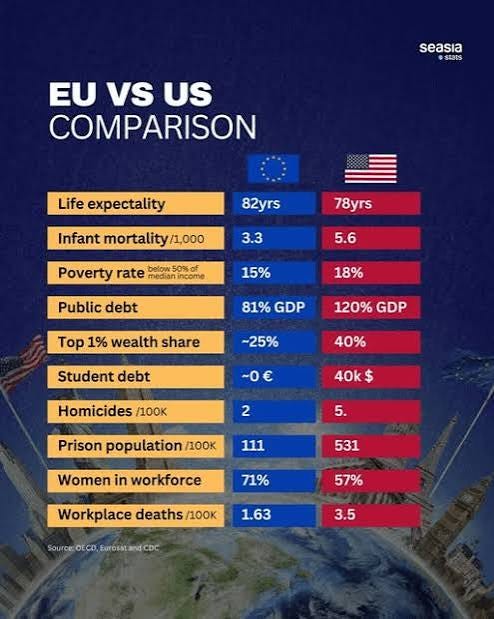
The quality of life in the EU is just better than in the U.S. And only the richest 10% of those in the U.S. compare favorably in wealth relative to their European counterparts. The bottom 90% in Europe – as measured by wealth – are better off than their US counterparts. Not in this graphic, but definitely part of the equation are universal healthcare in Europe, generous family leave and vacation policies.
Money ain’t everything.
The main problem that places like The Economist, The Financial Times and other defenders of the status quo have with degrowth is that it doesn’t properly place the accumulation of wealth as the top priority of society.
These attacks on degrowth are a good thing. Indifference would be worse. That these attacks on degrowth are coming from the cheerleading squad for capitalism should tell you that they are worried. They don’t seem to realize that their defenses only serve to highlight the failing of our current economic system, namely that it puts profit over people and planet. I encourage the Economist, the FT and the other defenders of the faith to continue their full-throated denunciations of degrowth. They will only succeed in introducing more people to the idea.
As if degrowth could be stopped. Poor delusional fools. They are in for a nasty surprise.
The only real question is whether we plan for the inevitable degrowth that has already started or whether we just fall down the metaphorical stairs.
Would we ever consider presenting the learning of ecological economics as something other than for or against Growth?
Might we consider a new framing? Something like a Growth vs. Save the World economy, where saving the world is not about perpetuating the present, but adaptively evolving to the changing circumstances of the changing times.
If we give ourselves space to imagine something different from Growth, something like Save the World, when we enter that space to deliberate on the possibilities, we will quickly find ourselves pulling on the threads of inquiry into why Growth matters, which quickly becomes an inquiry into to whom does Growth matter, which sooner or later leads to the insight that Growth is essential to securities trading markets professionals, as the primary driver of liquidity in the securities trading markets. But is there an alternative, for society, to securities trading for financing business at scale?
In the everyday spaces of everyday living, that may be unimaginable.
So, we need to create spaces that are not everyday spaces - spaces for inquiry and learning for deliberation and judgment - in which that which is unimaginable can be imagined, and investigated.