
Breaking America
The United States will break up in the next 50 years. Maybe sooner.

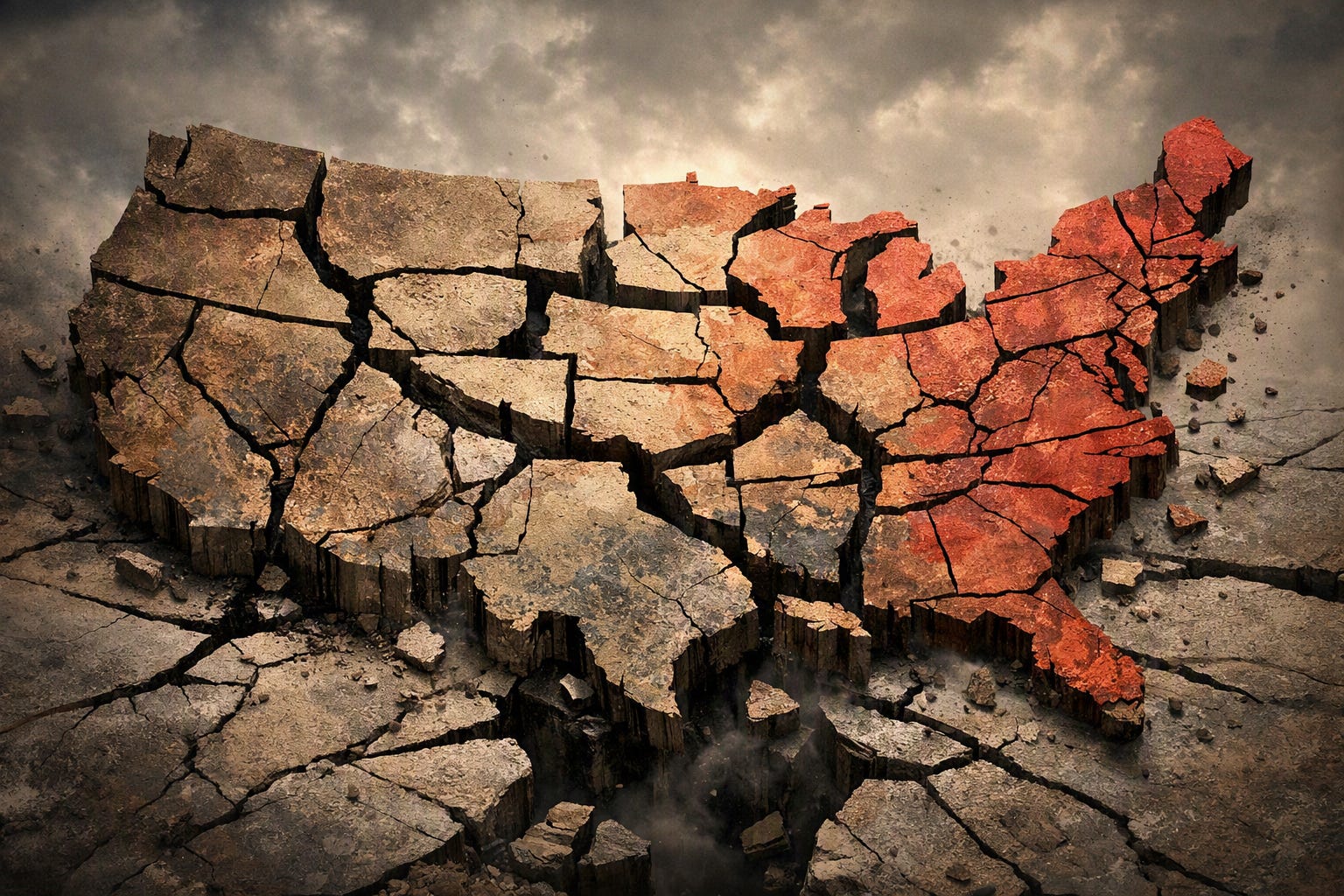
I was having a conversation with a few friends about a month ago, and the future of America came up. I asked them (there were three of us around the table) if they thought America in its current geographic form would exist in 50 years. I qualified that something small like Washington D.C., Puerto Rico or Guam becoming a state didn’t count . I was asking them if they thought there would be either a serious fracture or expansion of the US. They both said yes, assuming that the U.S. would break up in some way. I agreed.
Set the scene
Just so it is clear. I am not rooting for any particular outcome. History shows us that nation states change borders all the time. Look at the history of Europe, Africa, Asia or any continent over a 300 year period. If there are humans with governments in that continent - borders will change. So let’s take a look at the way the U.S. could collapse/grow. I’ll walk through the political / environmental / cultural changes that might bring about a shift in borders and you tell me how wrong I am. Deal?
Political
The current map of the United States has been relatively static since Hawaii and Alaska were added in 1959. The “lower 48” has been in place since 1912, when Arizona became a state. The United States is blessed with an absurdly stable “political geography” - if that is even a thing. The U.S. has two huge moats in the Atlantic and Pacific Oceans, the most polite country in the world to our North and Mexico - which offers no political or military threat to the South. The United States is too big, and too strong to be invaded by an outside force. Sure some country could eventually hurl nuclear warheads at the U.S., but that would just ensure that countries’ destruction, so I’m not counting that as a real “threat” for this thought experiment.
The only way that the United States can be torn apart politically, is from the inside.
The U.S. is doing an excellent job of doing just that. With no unifying foreign enemy to fight the U.S. has begun to turn on itself.
The elites in the United States have employed a successful divide and conquer strategy from the elites pitting everyone against each other. If the U.S. population ever decided to unite along something approximating class lines - watch out. We may be in the early stages of that as inequality is at an all time high, the elites of society seem to have given up on the whole democracy idea in favor of some kind of techno feudalism or fascism with capitalism tacked on. I find it easy to see some kind of violent uprising in a country one-third of people have trouble just getting by, cannot afford a $1K emergency, are not confident in the future of American democracy, and have more guns than people.
The current political state is untenable. They Democrats are having their own Tea-Party moment, rediscovering that they used to call themselves Social Democrats - and people liked it.
Will that bring about a utopian post-growth world in which we as a society can admit that we have enough and live in harmony with one another. No. I think the current open talk in Democratic circles to moving to a more Scandinavian style of Social Democracy is just the normal swinging of the pendulum. It will make discussions about degrowth more acceptable, but no one is going to campaign on degrowth.
Increased political fracturing in the coming years will continue, exacerbated by environmental breakdown, depopulation, slower economic growth and cultural changes we can’t even imagine yet. That sounds like a recipe for shaking up the borders of a nation state.
Cultural
Politics follows culture - so it is the culture that will change first. I am not going to begin to guess how exactly American culture will change in 50 years, I only know that it will. Think of the culture of America in 1976 and try to tick off all the cultural changes the U.S. has experienced. Now add to the mix the volatile and angry politics we just talked about, technological change, and increasing environmental devastation and there is no way that our culture won’t violently change - perhaps with real violence mixed in as well.
More people will likely be growing their own food, providing their own energy, and living more locally focused lives - not out of choice, but out of necessity. The Limits to Growth and Gaya Herrington’s recent update, both showed that we are likely entering some sort of “collapse”. That doesn’t mean that everyone dies on a specific date on the calendar, but it does mean that we are likely guaranteed to live through a steep dropoff in the metrics of growth that we worship today.
The citizens of the United States will likely live simpler, less materialistic and growth focused lives in 50 years, and likely well before that. Whether the citizens of America think of that as a good thing or a catastrophe will depend on the culture of the time. I would hope that we have designed our way there as much as we can, but it could be cascading disasters that get us there.
In such a scenario, the ability of a nation state as large and far flung as the United States to provide security, economic opportunity, healthcare and even food will be compromised. I see us moving to more bioregional models by necessity. We will know our neighbors more in 50 years because we will need to depend on them more and they will need to depend on us. There will likely be less the nation state can provide for us - which makes it easier to imagine any nation - much less one as sprawling as the U.S. starting to fracture.
Environmental
This is where the question of America’s border in the future turns into a trick question. Take a look at a projected map of Florida, 25 years from now.
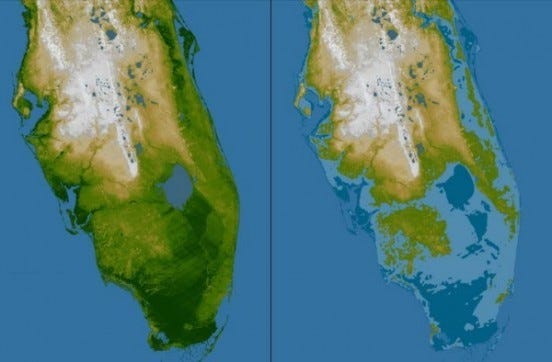
Source: The World in 2050 by Laurence C. Smith
Or take a look at the projected map of North America 100 years from now.
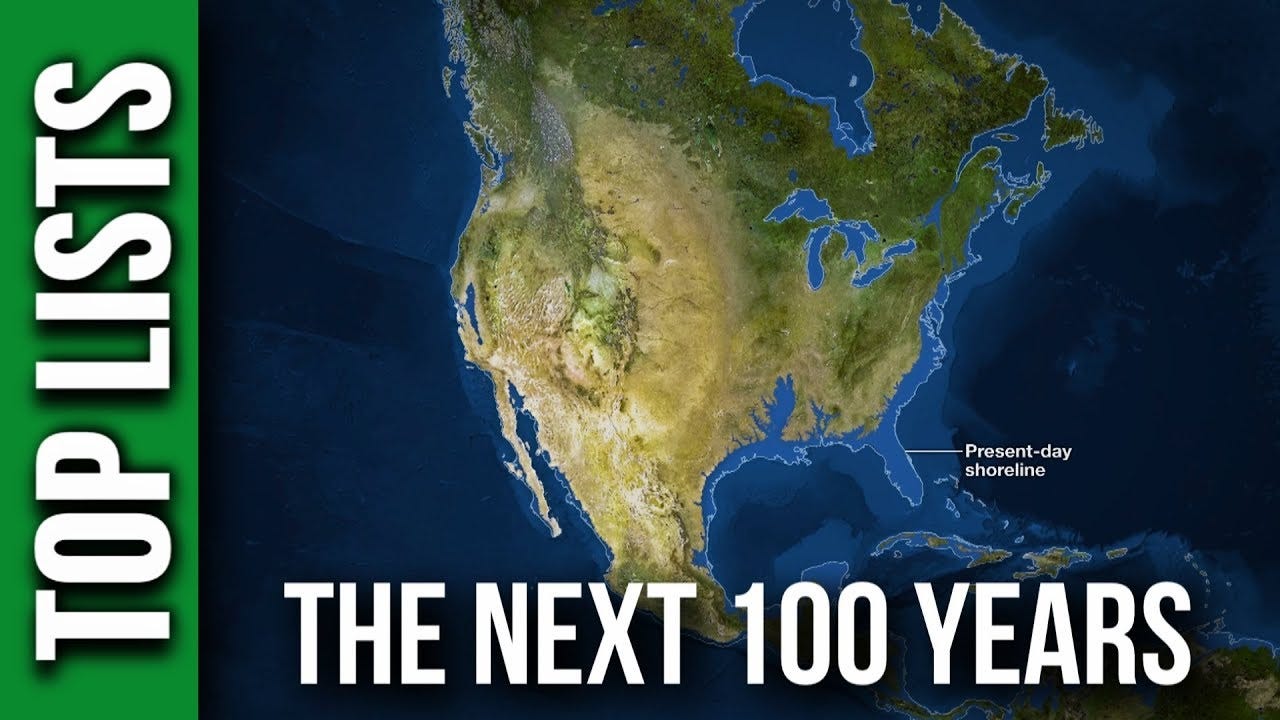
And that is just coastal flooding. The environmental stressors of increased heat, increased instances of mosquito borne diseases, increased wildfires, increased flooding from storms, increased crop failure, increased intensity of storms coupled with decreased availability of food will test the ability of the United States to hold together.
As you can see from the graphics above, the sea is set to take back Florida and move an inland sea up the Mississippi river delta. Land will also be lost to increased heat that will make more places in the United States uninhabitable, or less likely to support life as we know it today.
Expansion
Expansion is possible because expansion of borders has always been a resource play. As environmental damages increase, the need to expand may be seen as an attractive alternative. As climate change moves the bread basket of the continent northward, the United States may feel the need to move its borders northward into Canada.
Military adventurism has often been used to distract a dissatisfied populace back home. It is therefore not inconceivable that some future U.S. administration may roll the dice on a military adventure to “conquer” new territory in order to project strength. The farcical attempts of the current administrations to wishcast Canada, Greenland or some other unfortunate place into a 51st state may become a reality if U.S. leaders feel that it can be quite discontent back home in the short-term.
However, Ukraine has shown how a new technology - the defensive militarized drone - can change the military landscape. Ukraine has repelled a much larger Russian Army partially because it can simply destroy large Russian military assets that cost millions of dollars - which are drones that cost less than a cheap car. Any nation that gets any ideas of military adventurism will likely have to deal with an opponent that can retaliate in ways that were not an option just a few years ago.
The best option might not be expansion, but a strategic retreat.
In conclusion
Many people reading this essay likely saw the headline and thought it preposterous that the United States could break apart the next 50 years. Recency bias is a powerful thing. We expect the world tomorrow to look much like it did yesterday.
But it will not. It cannot.
The political / cultural / environmental forces at work are just too strong for the United States to survive in its current form. I’m guessing it will break apart or shrink in some way. Beyond land loss to a hungry ocean and land lost to heat stresses and environmental devastation, I don’t know what form that crack-up will take.
The United States has been held together over the years by hatred of a common enemy, belief in a common God, the perceived solidarity of a rather homogeneous race (although race is just a social construct), all of which are fading. The gospel of growth and the American dream it could deliver held things together too - but that is not only fading, but becoming realized as a force of self-destruction itself.
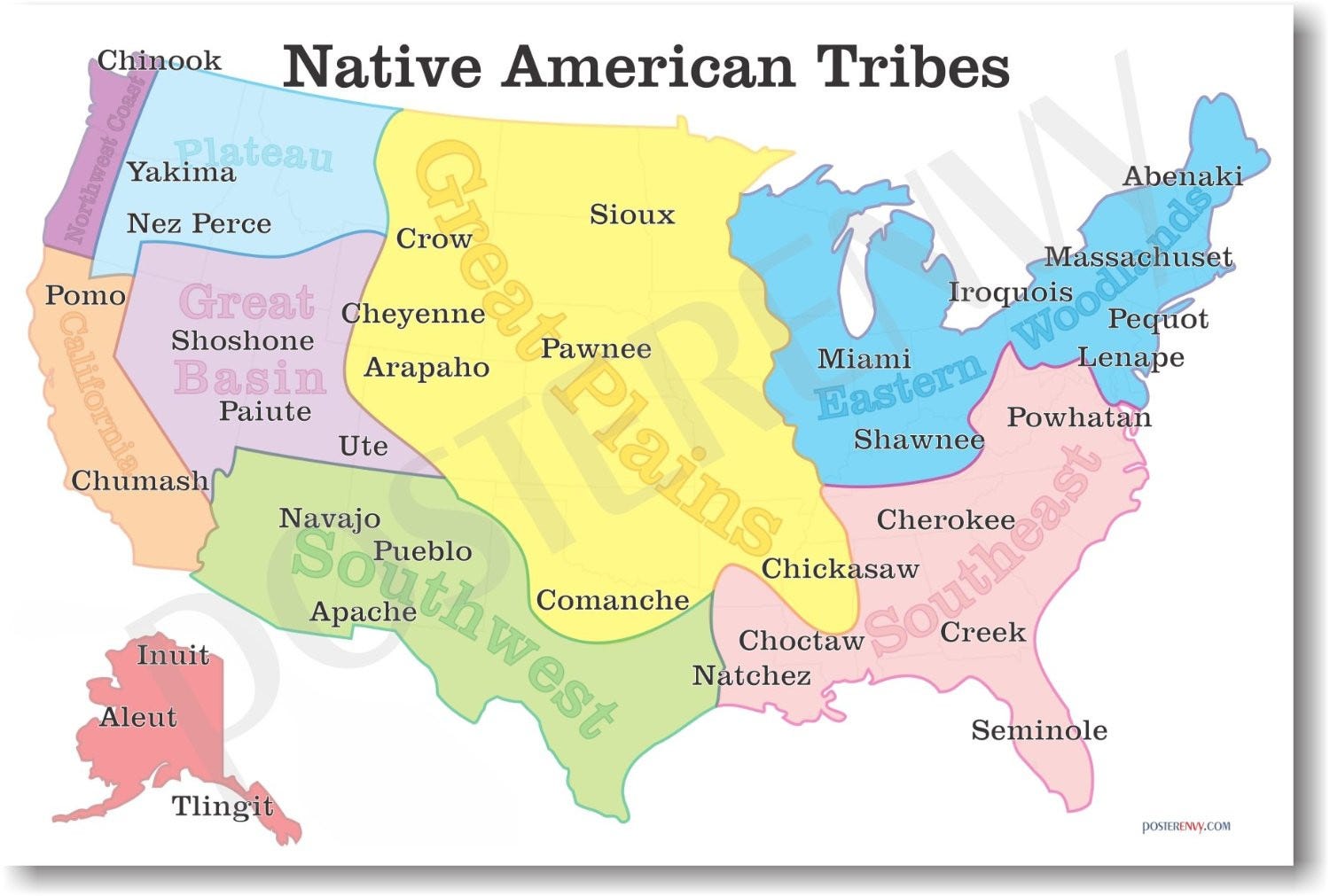
The continent of North America has been here before though. I imagine in 50 years we will be on our way to an existence that is more bioregionaly focused. We will not be able to depend on a national government to provide what it does today. We will have to focus more on protecting the natural resources of our bioregion, and we will have to work with those around us to survive and maybe even thrive in the places we now call home.
It might look something like this:
What do you think?
I’ve attached a poll below to share your guesses. But please engage in the comments if you want to explore this topic more.
50 years? Sooner? Maybe? No way to tell. Only time will tell. One can speculate.
Alaska and Hawaii became states in 1959.